

CPT Guides
H0001 CPT Code: Billing the Alcohol and Drug Assessment
10 min read
You'll be able to decide which code a session supports based on face-to-face minutes and the notes behind them.
Cipher Billing
Behavioral Health Billing Team
You'll be able to decide which code a session supports based on face-to-face minutes and the notes behind them.
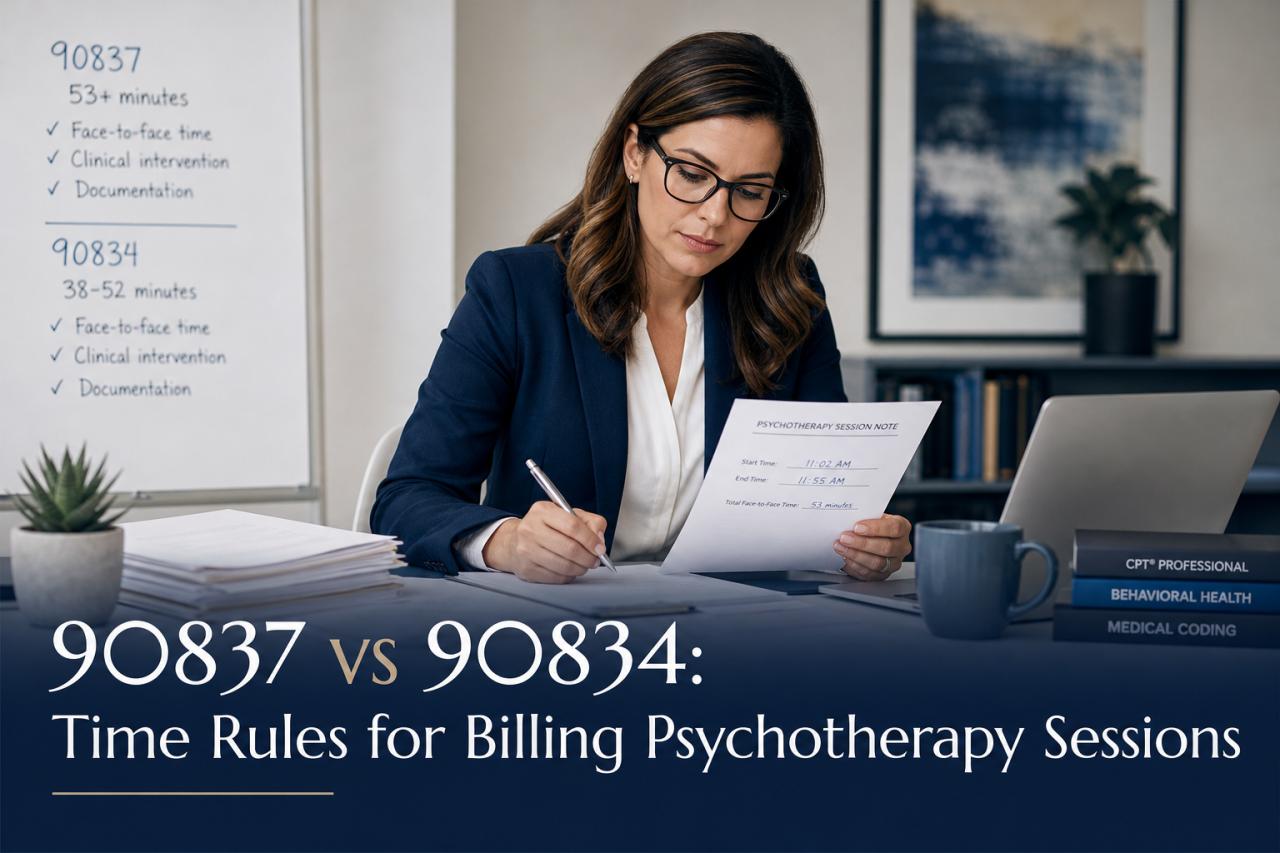
Bill 90837 when you spent at least 53 minutes in face-to-face psychotherapy with the patient, and bill 90834 for sessions of 38 to 52 minutes. In the 90837 vs 90834 decision, the clock and the note decide the code, not the scheduled hour. Payers read the documented start and stop times first, so those entries need to hold up on their own.
The AMA, which owns the CPT code set, sets three timed psychotherapy tiers for a patient alone or with family: 90832 starts at 16 minutes, 90834 at 38 minutes, and 90837 at 53 minutes. CMS publishes the same thresholds in its Medicare claims guidance. A session under 16 minutes isn't billable as psychotherapy at all, so a brief check-in belongs in a different service category or goes unbilled.
Each code covers a span, not a single number. A 45-minute session falls in the 90834 range, and so does a 52-minute session. A 50-minute appointment slot is the classic trap. Clinicians often assume the slot equals 90834 and the 60-minute slot equals 90837, but a 60-minute appointment that includes five minutes of intake chatter and a late start can land at 52 minutes of actual therapy.
The count is face-to-face psychotherapy time with the patient, or with the patient and a family member when the patient is present for some or all of the visit. Time spent on scheduling, billing talk, waiting, writing the note, or phone calls with other providers doesn't count toward the threshold. Telehealth sessions are timed the same way, and we cover the claim details for them later in this guide.
Before you set a coding rule for your clinicians, confirm these points in the payer's current provider manual:
Rules vary by payer, plan, state, and contract, so the CPT book is your baseline and the payer's policy is the final word. Our behavioral health coding guide shows where these code families sit alongside the rest of your outpatient claims.
A reviewer opening your note should be able to rebuild the code in about ten seconds. That means a start time, a stop time, and a total that agree with each other and clear 53 minutes. A note that says "60-minute session" with no clock times asks the reviewer to take your word for it, and many payers won't.
Three details do most of the work:
That third point catches practices off guard. A 53-minute claim backed by two sentences of clinical content invites the question of what filled the hour. Notes don't need to be long, but they should show enough therapeutic work that the time is believable.
Our onboarding starts with an audit of your documentation before claims go out, and this is where we most often look. Pull a sample of recent 90837 notes and check whether the times vary naturally, whether the totals match the clock entries, and whether your EHR template forces a default duration that clinicians never edit. We work inside your existing EHR, so fixing a template field usually doesn't mean changing software.
Confirm the exact time-entry requirement in each payer's current provider manual, since some accept total minutes and others expect clock times.
A 60-minute code pays more than a 45-minute code, so payers watch the mix. If most of a clinician's psychotherapy claims land on 90837 while peers in the same specialty bill a spread of 90834 and 90837, that pattern can prompt a records request. The trigger is usually the distribution, not any one claim, which means a perfectly documented note can still be pulled because of the clinician's overall profile.
Payers publish their own review policies in provider manuals and bulletins, and the details differ by payer, plan, and state. Check the specific payer's current policy before assuming how a review works, and don't rely on what another practice reports hearing from a different plan. We won't name a payer program here, because only the payer's own published material can confirm one exists.
Some patterns that tend to draw attention, in structural terms:
Nearly identical start and stop times across a clinician's notes
Totals that always land exactly on the minimum or exactly on 60
A 90837 share that sits well above the practice's other clinicians with similar caseloads
Notes with thin clinical content attached to long sessions
Expect a review to arrive as a request for records, often covering a sample of dates of service. The payer compares your times, totals, and clinical content against the claim. If the notes don't support the code, the usual outcomes are a downcode to 90834, a recoupment of past payments, or a longer prepayment review of future claims. Which of those applies depends on your contract and the payer's policy. Our page on pre-payment review explains how that process works for behavioral health claims.
Run your own distribution report by clinician each quarter, before a payer does it for you. If one clinician stands out, read a handful of that person's notes against the thresholds from the previous section and correct the habit, not just the claim.
Two different add-on families attach to timed psychotherapy, and they work in opposite ways. Code 90785 covers interactive complexity, which the AMA describes in plain terms as communication barriers that make the session harder to deliver, such as a caregiver conflict, a required interpreter or device, or a mandated report. It adds to the primary service without changing the time tier. You still pick 90834 or 90837 from the minutes, then attach 90785 only when the note documents the specific barrier. A diagnosis alone doesn't qualify, and payers commonly exclude it from certain primary services, so check the current policy.
Codes 90833, 90836, and 90838 work differently. They apply when a prescriber, such as a psychiatrist or nurse practitioner, delivers an evaluation and management (E/M) visit and a separate psychotherapy service in the same encounter. The add-on's tier reflects only the psychotherapy minutes, so 90833 matches the shortest range, 90836 the middle, and 90838 the longest. The AMA owns these definitions, so confirm the exact minute ranges in the current CPT book.
Three points keep these claims clean:
The E/M code is chosen on its own documentation, not on the therapy time.
The psychotherapy minutes must be separate from the minutes spent on the medical work, and the note should record both.
Non-prescribers don't bill these add-ons, because they have no E/M visit to attach them to.
The practical risk is double counting. If a clinician records a 40-minute visit and claims both an E/M and 40 minutes of therapy, the reviewer will see the same time used twice. Build your EHR note so medical and therapy minutes are separate fields.
Modifier use on these claims varies by payer, and our behavioral health billing modifiers post covers how to check it.
The time thresholds stay the same on a video or audio visit, but the claim carries two extra pieces of information: the place of service and, for many payers, a telehealth modifier. Those two fields are where telehealth psychotherapy claims most often go wrong, and they don't affect the minutes you've already counted.
The place of service (POS) code tells the payer where the patient was, and CMS publishes the code set and its Medicare telehealth guidance. For a patient at home, some payers expect one POS code and others expect the code that matches where the clinician would have seen the patient in person. Medicare has changed its handling of these fields over time, so read the current CMS telehealth guidance rather than relying on last year's billing habits.
Modifiers are the second piece. Some payers want a telehealth modifier on 90834 and 90837, and others want audio-only identified separately. Our behavioral health billing modifiers post walks through how to check this, and the telepsychiatry billing and reimbursement basics post covers the prescriber side of the same visits.
Telehealth notes need a few lines beyond the usual start and stop times:
The modality used, video or audio-only, since payers treat them differently.
The patient's location at the time of the session, and the clinician's location if the payer asks for it.
Any connection problem that cut into the session, with the minutes that remain after it.
That last entry matters most for the 53-minute line. A dropped call that costs eight minutes can move a 90837 down to 90834, so record the real clock times, not the scheduled hour.
Coverage for telehealth psychotherapy, allowed modalities, and state licensure rules vary by payer, plan, state, and contract. Confirm them in the payer's current provider manual, the state Medicaid manual, or the CMS telehealth pages before you build a rule for your clinicians.
CMS publishes Medicare rates for 90834 and 90837 in its Physician Fee Schedule lookup tool on cms.gov, so you never need to rely on a number someone quotes from memory. Search by CPT code, pick the year, and choose your Medicare Administrative Contractor (MAC) locality, since the payment amount is set by geographic area and changes when CMS publishes its annual update. The amounts you see are Medicare's allowed amounts for that locality, and your commercial and Medicaid plans set their own.
Look at three things on the results page. The first is the facility versus non-facility setting, which matters because many outpatient psychotherapy visits are billed in the office setting. The second is the status indicator and any listed limits for the code. The third is the effective date, so you don't compare a 2025 amount against a 2026 claim.
Commercial plans price from their own fee schedules, which are written into your contract. If the Medicare figure is your benchmark, treat it as a reference point and then read your contract's fee schedule line by line. When a plan's 90837 rate looks low against what you expect, our post on negotiating better behavioral health reimbursement rates covers how to raise it at renewal.
Rules and rates vary by payer, plan, state, and contract. Confirm each one in the payer's current fee schedule or provider manual, and use the CMS lookup for anything Medicare-specific.
If you'd like a second set of eyes on how your 90834 and 90837 claims are documented and coded, our mental health billing services team can start with a free facility billing audit. Request it at /contact-us, and a dedicated U.S.-based Partner Experience Executive will walk through your notes with you.
*This post is educational and isn't legal or coding advice.*
AMA, CPT code set (owner of 90832, 90834, 90837, 90785, 90833, 90836, and 90838)
CMS, Physician Fee Schedule lookup tool (cms.gov)
CMS, Medicare telehealth guidance and place of service code set
Each payer's current provider manual and state Medicaid manual
About the Author
Behavioral Health Billing Team
In This Article
Topics



Cipher Billing specializes in behavioral health revenue cycle management. Reach out for a free consultation and see how we can maximize your reimbursements.