
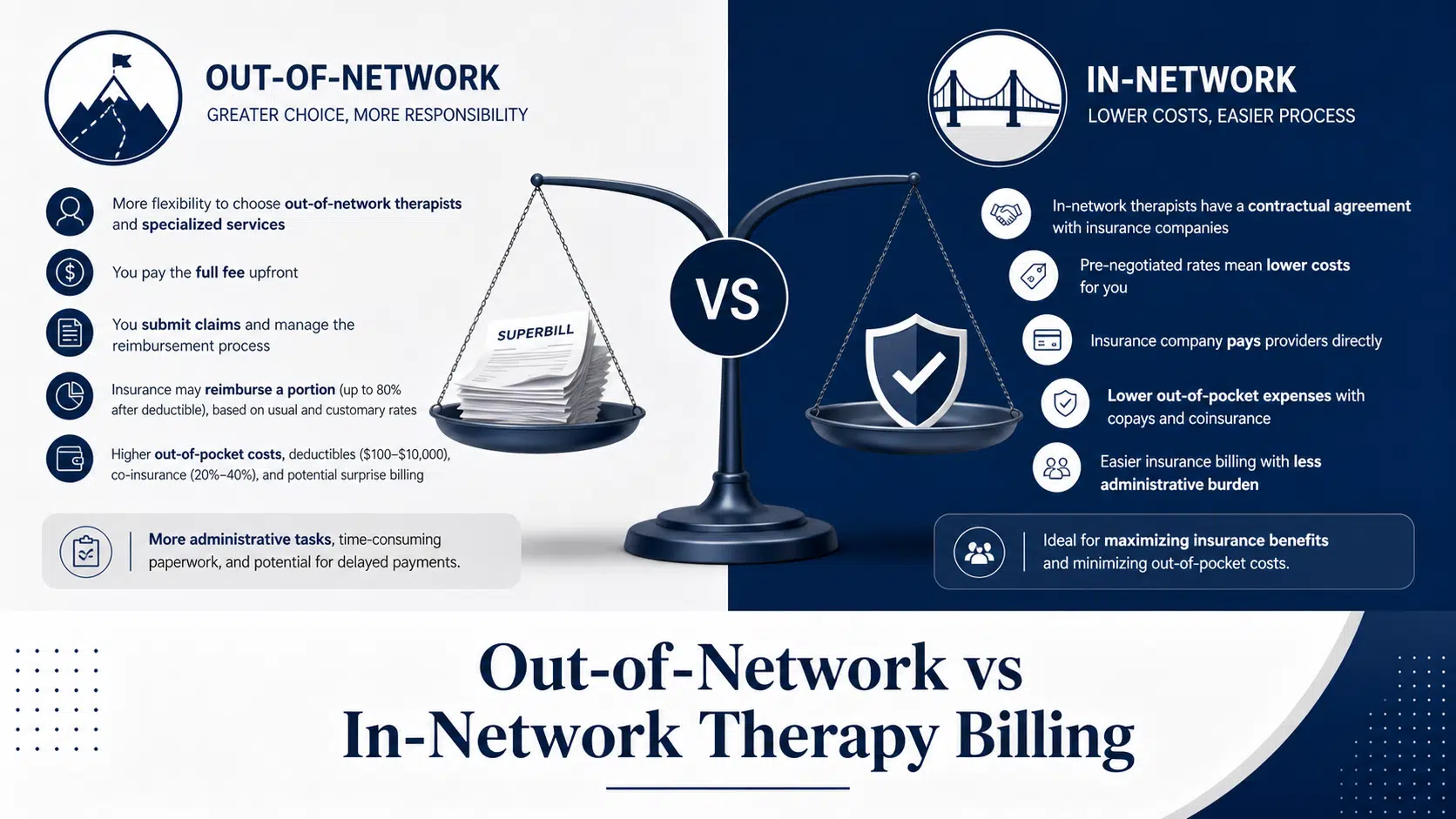
Out-of-Network vs In-Network Therapy Billing
10 min read
In behavioral health, cash flow problems rarely announce themselves with a bang. They creep in quietly, hidden inside spreadsheets and EOBs, masked by metrics that look “good enough” on the surface. By the time most facility owners notice the squeeze, weeks of revenue have already slippe
Cipher Admin
Cipher Billing Team
In behavioral health, cash flow problems rarely announce themselves with a bang. They creep in quietly, hidden inside spreadsheets and EOBs, masked by metrics that look “good enough” on the surface. By the time most facility owners notice the squeeze, weeks of revenue have already slippe
In behavioral health, cash flow problems rarely announce themselves with a bang. They creep in quietly, hidden inside spreadsheets and EOBs, masked by metrics that look “good enough” on the surface. By the time most facility owners notice the squeeze, weeks of revenue have already slipped through the cracks.
The truth is, your top-line revenue number can look healthy while your cash position quietly bleeds out. Why? Because behavioral health billing is uniquely complex—medical necessity scrutiny, out-of-network negotiations, lengthy authorizations, and frequent denials all conspire against a clean revenue cycle. The facilities that thrive aren’t the ones with the highest billed charges. They’re the ones tracking the right Key Performance Indicators (KPIs).
Below are three KPIs that quietly impact cash flow for behavioral health providers—metrics most administrators underestimate until it’s too late.
Unlike general medical billing, behavioral health revenue cycles are governed by extended levels of care (Detox, RTC, PHP, IOP), stringent utilization review requirements, and a heavy reliance on out-of-network reimbursement. According to the SAMHSA 2022 National Survey on Drug Use and Health, only a fraction of those needing substance use treatment actually receive it—and reimbursement complexity is one of the biggest barriers to facility sustainability.
That means even a small inefficiency in your revenue cycle can have an outsized impact on your bottom line. Let’s look at the three KPIs that quietly determine whether your facility scales or stalls.
Most facilities treat VOB as an administrative checkbox. In reality, it’s the very first link in your cash flow chain—and the slowest link breaks the whole system.
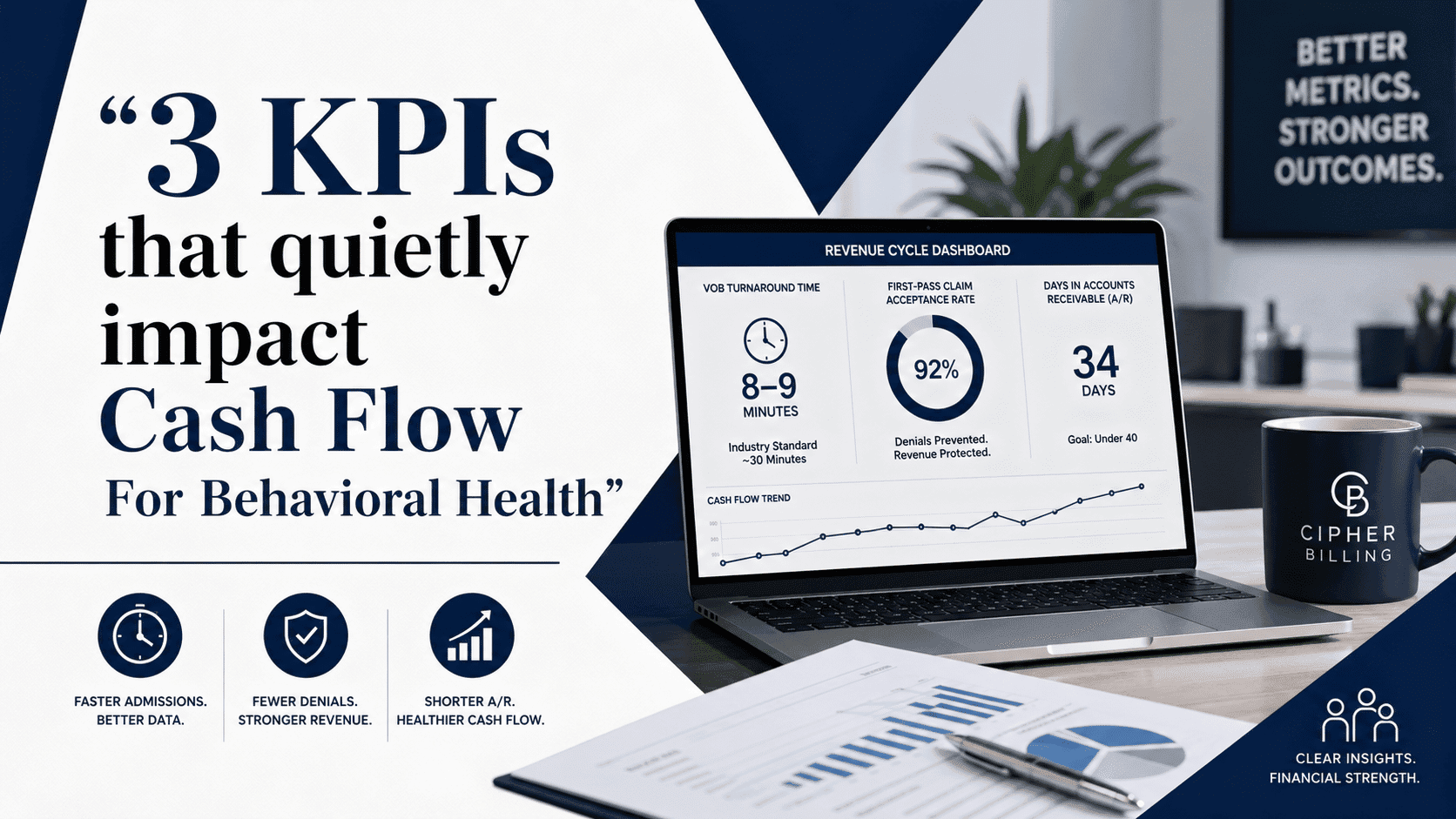
The industry standard for completing a Verification of Benefits is roughly 30 minutes per call. That may sound reasonable until you stack it against admissions volume. Every minute a prospective patient waits for VOB confirmation is a minute they may walk to a competitor, a minute their motivation to seek treatment fades, or a minute that admission decisions get delayed.
At Cipher Billing, we’ve engineered our VOB process to deliver complete eligibility, historical data, and OON benefit details in just 8 to 9 minutes—nearly four times faster than the industry standard. That speed translates directly into faster admissions, more accurate billing, and stronger collections.
Your denial rate is the silent killer of behavioral health cash flow. The American Medical Association and other industry watchdogs have repeatedly emphasized that denial prevention—not denial management—is the true cost-saver. Once a claim is denied, the cost to rework it can range from $25 to $118, according to data referenced by the Medical Group Management Association (MGMA).
Industry-wide, initial denial rates hover between 10% and 15%, with behavioral health often skewing higher due to medical necessity disputes and complex authorization requirements. Worse, a significant portion of denied claims are never resubmitted at all—meaning that revenue is simply written off.
This is where Cipher’s audit-based onboarding makes a measurable difference. We perform comprehensive prospective audits on facility documentation before claims are ever submitted. The result? 92% of claims are paid without compliance intervention, and our medical necessity appeal success rate sits at 97%. When denials do occur, we engage a 24-hour denial response system with root-cause analysis—not just resubmission.
Days in A/R is the metric that tells you how long your money is sitting in someone else’s bank account. According to Healthcare Financial Management Association (HFMA) benchmarks, healthy facilities aim to keep Days in A/R under 40. Many behavioral health facilities, however, see this number creep into the 60–90 day range—or higher—because of OON complexity and prolonged utilization reviews.
Pair that with a low or unmonitored Out-of-Network reimbursement rate, and you have a recipe for chronic underperformance. Many facilities accept whatever payers offer, leaving meaningful dollars on the table.
Cipher Billing addresses both fronts simultaneously. Our team delivers same-day claim submission, daily payment posting, and a 100% post-payment and pre-payment review rate to catch underpayments instantly. On the OON front, our aggressive negotiation tactics have produced an average 30.36% OON reimbursement rate—and when payers don’t play fair, we escalate cases to insurance commissioners. That’s what relentless advocacy looks like.
The financial results speak for themselves: most Cipher partners receive their first payment within 30 days, and our write-off rate stays at an industry-leading 1.88%.
Each of these KPIs is powerful on its own. But they don’t operate in isolation—they compound. A slow VOB leads to inaccurate intake data, which leads to denied claims, which inflates Days in A/R, which crushes cash flow. Conversely, when you optimize all three, you create a revenue cycle flywheel that accelerates collections and stabilizes your facility’s financial future.
This is exactly why Cipher Billing operates exclusively in behavioral health and addiction recovery. Since 2017, we’ve built our entire infrastructure around denial prevention, transparent reporting, and the metrics that actually move the needle for facilities like Substance Abuse Treatment Centers, Residential Treatment Facilities, PHPs, IOPs, and outpatient mental health clinics.
Cipher’s “Higher Level Partnership” approach isn’t a marketing slogan—it’s an operational framework. Here’s what that looks like in practice:
Behavioral health is too important—and too financially fragile—to leave revenue cycle management to chance. The three KPIs above (VOB turnaround, denial rate, and Days in A/R combined with OON reimbursement) quietly determine whether your facility grows, stalls, or shrinks.
If you’re not measuring them weekly, you’re flying blind. And if your current billing partner can’t deliver transparent reporting on every one of them, it’s time to ask why.
Cipher Billing is built specifically for behavioral health providers who refuse to settle for “good enough.” If you’re ready to see what a true revenue cycle partnership looks like, we’re ready to show you.
Contact Cipher Billing today to schedule a complimentary revenue cycle review:
About the Author
Cipher Billing Team
In This Article
Cipher Billing specializes in behavioral health revenue cycle management. Reach out for a free consultation and see how we can maximize your reimbursements.