
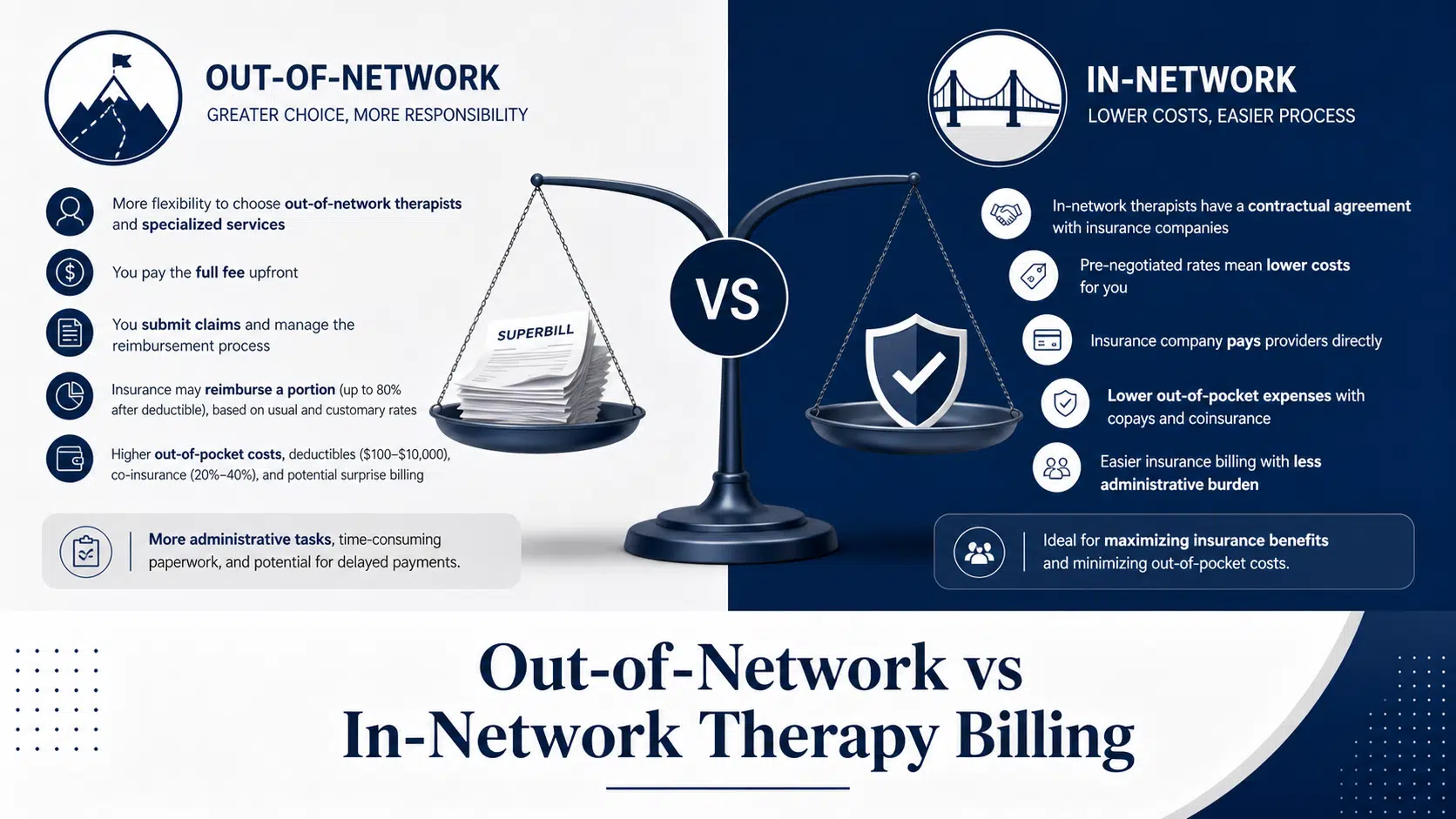
Out-of-Network vs In-Network Therapy Billing
10 min read
Behavioral health organizations are under unprecedented pressure. Reimbursement models are shifting, payer scrutiny is intensifying, and the documentation requirements tied to mental health and substance abuse treatment grow more complex every quarter. For many behavioral health providers, the quest
Cipher Admin
Cipher Billing Team
Behavioral health organizations are under unprecedented pressure. Reimbursement models are shifting, payer scrutiny is intensifying, and the documentation requirements tied to mental health and substance abuse treatment grow more complex every quarter. For many behavioral health providers, the quest
Behavioral health organizations are under unprecedented pressure. Reimbursement models are shifting, payer scrutiny is intensifying, and the documentation requirements tied to mental health and substance abuse treatment grow more complex every quarter. For many behavioral health providers, the question is no longer if they should outsource their revenue cycle — it’s how to choose the right partner. This guide on behavioral health revenue cycle outsourcing what to evaluate will walk you through the criteria that separate a transactional vendor from a true strategic partner.
Unlike general medical billing, behavioral health billing operates in a specialized universe of time-based therapy codes, authorization-heavy utilization review, and highly subjective medical necessity determinations. Behavioral health practices face unique challenges in revenue cycle management due to complex billing scenarios, strict documentation requirements, and evolving reimbursement models.
Mental health conditions — from severe depression to co-occurring substance use disorders — require layered clinical documentation that payers scrutinize at every level of care. This makes behavioral health RCM far more nuanced than standard medical billing, and it’s why generic RCM vendors often struggle to deliver results in behavioral health settings.
Behavioral health revenue cycle management requires adherence to specific regulations, such as HIPAA and 42 CFR Part 2, which govern the confidentiality and handling of patient information. Behavioral health practices must navigate a complex web of regulations, including HIPAA, 42 CFR Part 2, and state-specific mental health laws, all while managing their revenue cycle.
Staying on top of regulatory compliance is becoming overwhelming for many healthcare providers, as new regulations and compliance requirements emerge at an unprecedented pace. According to guidance from the U.S. Department of Health & Human Services, compliance issues in healthcare can lead to significant penalties and financial losses for practices, making it essential to stay informed about changing regulations and payer requirements.
Understanding revenue cycle management starts with recognizing that the revenue cycle spans the entire patient journey — from scheduling and insurance verification through final payment posting. In behavioral health, the revenue cycle touches clinical operations more directly than in most healthcare settings because billing interactions can affect the therapeutic relationship, necessitating a patient-centric approach in communications.
The three pillars of revenue cycle management are:
A strong partner in behavioral health revenue cycle management must excel at all three — weakness in any pillar compromises financial performance and cash flow.
A rise in claim denials and rejections could indicate documentation issues, coding errors, or compliance problems, suggesting that outsourcing RCM may help minimize denials and maximize revenue collection. Other common triggers include:
Many behavioral health providers find that outsourcing RCM allows them to focus on patient care while expert teams manage complex billing processes, leading to improved cash flow and reduced billing errors.
When vetting partners for your behavioral health revenue cycle, surface-level promises aren’t enough. Here’s the evaluation framework Cipher Billing recommends — built from eight years of operating exclusively in behavioral health RCM since 2017.
The partner must have experience with behavioral health CPT codes, time-based therapy billing, and navigating complex payer requirements for Medicaid and Medicare. Generic medical billing companies lack the specialized knowledge to defend medical necessity for residential treatment, PHP, IOP, and outpatient mental health services.
Ask prospective vendors how many behavioral health organizations they currently serve, what percentage of their book of business is dedicated to mental health and substance abuse treatment, and whether they understand the clinical nuances that drive proper coding. Cipher, for example, has operated exclusively in denial prevention and billing for mental health and addiction recovery — nothing else.
What is the best way to evaluate revenue cycle management performance? Demand data. A high-quality partner should target a clean claim rate of over 95%, days in Accounts Receivable (A/R) under 45 days, and a denial rate below 5%.
Cipher’s published benchmarks set a higher bar:
The vendor must be fully HIPAA-compliant, adhering to privacy laws such as HIPAA and 42 CFR Part 2, and should have security audit policies in place. Proactively managing changes in coding regulations and payer policies is necessary for compliance in behavioral health billing. Ensure your partner conducts regular audits, maintains robust data security protocols, and keeps your practice remains compliant as regulations evolve. The Substance Abuse and Mental Health Services Administration offers detailed guidance on 42 CFR Part 2 that every behavioral health RCM partner should know cold.
The partner should demonstrate capabilities in denial management and appeals, with a successful track record in overturning denied claims, particularly for medical necessity. Proactive denial management and pre-submission claim audits can help reduce claim denials, which in turn improves the speed of patient payment collections and overall cash flow for practices.
Implementing proactive denial management strategies, such as automated claim scrubbing and structured appeals processes, can significantly reduce denial rates and recover lost revenue. Cipher’s 24-hour denial response protocol — including root-cause analysis and escalation to insurance commissioners when warranted — is designed to protect every dollar.
A dedicated account manager is important in behavioral health RCM to provide personalized support and understanding of specific practice needs. Cipher assigns every facility a U.S.-based Partner Experience Executive rather than routing you through a generic queue. That single point of contact understands your programs, your payer mix, and your clinical documentation standards.
EHR integration is crucial for reducing data entry duplication and improving efficiency in billing processes, using modern technology for eligibility verification and claim scrubbing. Your RCM partner should work seamlessly inside Kipu, Avea, Sunwave, ZenCharts, or whatever platform your clinical team uses. Forcing your clinicians to learn new practice management software defeats the purpose of outsourcing.
Regular reporting and transparency are vital for evaluating the performance of the RCM partner and ensuring accountability in billing. Utilizing data analytics to monitor key performance indicators (KPIs) can help identify revenue cycle strengths and weaknesses, allowing practices to make informed decisions to improve financial performance.
Behavioral health organizations repeatedly fall into the same traps when managing their revenue cycle in-house or with the wrong partner:
What are key RCM performance indicators every behavioral health practice should monitor? According to the Healthcare Financial Management Association, the most critical revenue cycle performance metrics include:
These KPIs give behavioral health providers a real-time pulse on financial operations and overall financial health.
Collecting payments from patients has become increasingly challenging, particularly due to the rise of high-deductible health plans, which can lead to confusion about financial responsibilities and delayed payments. Implementing clear financial policies and offering multiple payment options can significantly enhance patient payment collection by ensuring patients understand their financial responsibilities upfront.
A thoughtful billing process also helps enhance patient satisfaction and enhance patient outcomes — because financial confusion is one of the fastest ways to erode trust and disrupt continuity of care for mental health practices.
Cipher Billing was built from the ground up for behavioral health services. Our tailored solutions serve substance abuse and addiction treatment centers, residential treatment facilities, partial hospitalization programs, intensive outpatient programs, and outpatient mental health clinics.
Before submitting a single claim, Cipher performs a comprehensive prospective audit of your documentation, identifying compliance risks and coding errors that would otherwise lead to denied claims.
Full eligibility and out-of-network benefit data delivered in under 10 minutes — protecting patient access and eliminating admission delays.
Daily payer communication to secure authorizations, defend medical necessity, and extend patient stays when clinically warranted.
Same-day claim submission, daily payment posting, electronic remittance analysis, and relentless accounts receivable pursuit — the foundation of improved operational efficiency and stronger financial performance.
If a claim is denied, Cipher fights back. We escalate cases to insurance commissioners when necessary. That’s what “A Higher Level Partnership” means. Learn more about how CMS shapes payer behavior — and how an experienced team can use that knowledge to your advantage.
Outsourcing revenue cycle management to a specialized partner like Cipher gives behavioral health practices access to specialized expertise and advanced technology that streamline the entire revenue cycle and improve financial performance. The benefits compound quickly:
When billing operations are handled by an experienced team with specialized services tailored to behavioral health, leaders can finally stop firefighting and start scaling. That’s how practices maintain financial stability in a turbulent healthcare industry — and how they continue delivering high quality patient care without compromise.
If your behavioral health organization is weighing outsourcing revenue cycle management, Cipher Billing is ready to demonstrate what specialized behavioral health RCM looks like in practice.
Call us at (949) 368-0575, email info@cipherbilling.com, or visit CipherBilling.com. We’re located at 1665 Scenic Ave Suite 250, Costa Mesa, CA 92626, and available Monday through Friday, 8:00 AM – 5:30 PM PST.
Your clinicians got into this field to help people heal. Let Cipher handle the rest.
About the Author
Cipher Billing Team
In This Article
Cipher Billing specializes in behavioral health revenue cycle management. Reach out for a free consultation and see how we can maximize your reimbursements.