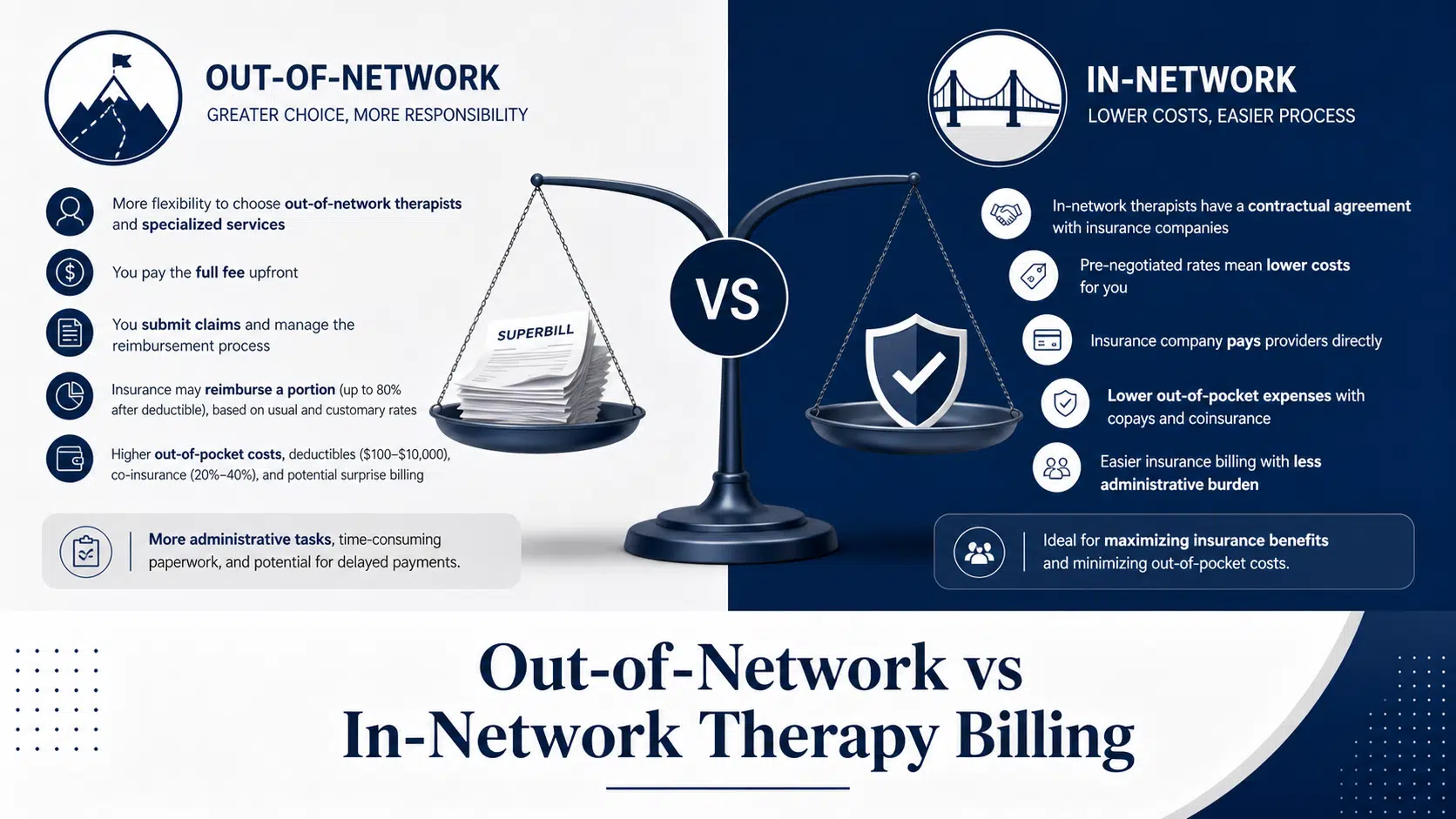
Out-of-Network vs In-Network Therapy Billing
10 min read
Key Takeaways CPT codes are five-digit numeric codes maintained by the American Medical Association (AMA) that describe services performed during mental health assessments, including diagnostic evaluations, screenings, and psychological testing. The primary assessment codes include 90791/90792 for p
Cipher Admin
Cipher Billing Team
Key Takeaways CPT codes are five-digit numeric codes maintained by the American Medical Association (AMA) that describe services performed during mental health assessments, including diagnostic evaluations, screenings, and psychological testing. The primary assessment codes include 90791/90792 for p
CPT codes are the standardized language of healthcare billing. These five-digit numeric codes describe medical services, including psychotherapy and mental health assessments, and are copyrighted and maintained by the American Medical Association. When you bill for a mental health assessment, the CPT code tells the payer exactly what service was performed.
Here’s the critical distinction: CPT codes describe the “what” (the procedure), while ICD-10-CM codes describe the “why” (the diagnosis). For example, you might bill 90791 for a psychiatric diagnostic evaluation while pairing it with F32.1 for major depressive disorder, single episode, moderate.
A mental health assessment can span a broad continuum—from a quick 90791 diagnostic interview to a multi-hour neuropsychological battery billed with 96130, 96131, 96136–96139, plus 90785 for interactive complexity when clinically appropriate.
Core concepts to remember:
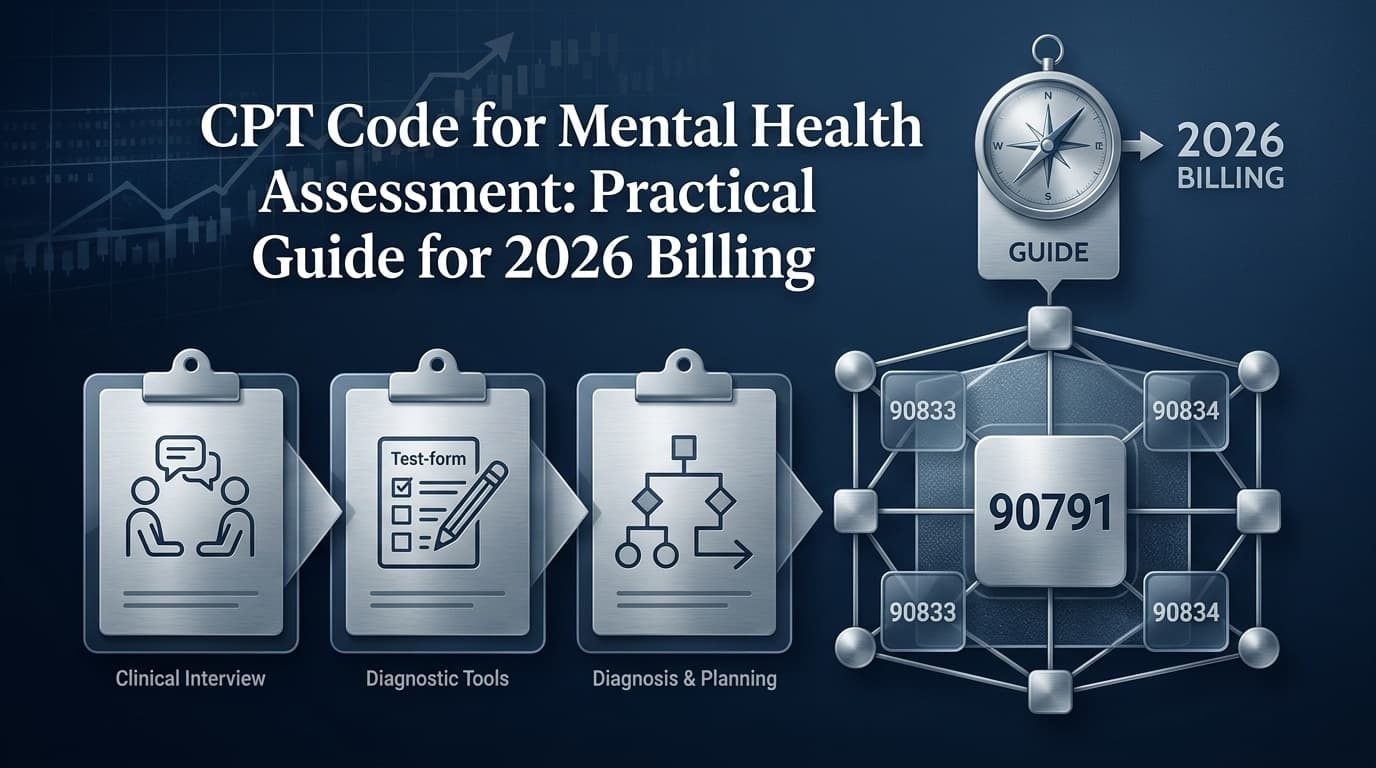
The backbone of initial mental health evaluations rests on two primary cpt codes: 90791 and 90792. Understanding when to use each is essential for clean claims.
CPT 90791 — Psychiatric Diagnostic Evaluation is a comprehensive assessment without medical services. Psychologists, social workers, LICSWs, LMFTs, and other non-prescribing clinicians typically use this code for new patient intakes. A full psychiatric assessment includes gathering detailed psychiatric, medical, family, and social/psychosocial history. The primary reason for an evaluation is reflected as the chief complaint in the patient’s own words. Risk assessments evaluate potential suicide, self-harm, or violence risks during these evaluations.
CPT 90792 — Psychiatric Diagnostic Evaluation with Medical Services is used by psychiatrists or nurse practitioners when medical interventions like prescribing medication or ordering labs are included. This code captures the clinical decision making involved in pharmacologic management and medication management.
Psychiatric diagnostic evaluations typically last between 45 and 90 minutes, with Medicare requiring a minimum of 16 minutes to bill for certain codes. Documentation must include history, mental status exam, diagnosis formulation, and treatment planning.
Patients can typically only be billed for the 90791 code once per episode of care or once every 6–12 months. Exceptions include major clinical changes, transfer to a higher level of care, or treatment gaps exceeding six months.
Facilities benefit from internal protocols distinguishing when to use 90791 versus 90792, including appropriate telehealth modifiers and place-of-service codes. Cipher Billing can align those rules with payer contracts to prevent denials.
The mental health assessment process typically consists of three main stages: screening, testing, and evaluation, each serving a distinct purpose in the overall assessment workflow. Selecting the right code depends on where your service falls on this continuum.
Screening involves brief instruments like the PHQ-9 or GAD-7, billed under 96127. During the screening stage, a brief emotional/behavioral assessment is conducted using standardized instruments, which helps identify individuals who may require further evaluation.
Testing means structured administration of two or more tests—think MMPI-2, WAIS-IV, or Conners scales—using 96130–96139 and 96146.
Evaluation is the clinical synthesis: integrating clinical data, interpreting results, and formulating a treatment plan.
Following a positive screening result, targeted testing is performed to gather more detailed information about the patient’s cognitive and emotional state, which is then documented and interpreted by a qualified healthcare professional. The evaluation stage involves the clinician interpreting the results of the tests administered, integrating clinical data, and formulating a treatment plan based on the findings.
Common compliance mistakes:
CPT 96127 covers brief emotional/behavioral assessment per standardized instrument, including scoring and documentation. This code applies to instruments like GAD-7, PHQ-9, Vanderbilt ADHD scales, and SCARED for pediatric anxiety.
The 2026 Medicare national average reimbursement hovers around $4.97 per unit, with most payers allowing up to three units per date of service (totaling approximately $14.91). Commercial rates vary by geography and contract.
When to use G0444 instead: Medicare mandates G0444 ($18.25) specifically within Annual Wellness Visits for depression screening. Use 96127 outside wellness visits or for non-Medicare payers.
For office visits combining a primary service with screening, providers often append modifier 25 to the E/M or psychotherapy code. An appropriate modifier (59 or XE) on 96127 shows it’s a distinct service performed, reducing “bundled service” rejections that plague 15–25% of claims per industry audits.
Cipher Billing helps facilities standardize when and how to bill 96127, ensuring proper documentation of the standardized instrument used, test results, and clinical application.
Since the 2019 CPT overhaul, psychological and neuropsychological testing uses distinct stages of codes for evaluation versus administration. CPT codes for mental health services are subject to change, with significant updates occurring in 2019, and it is essential for providers to stay current to ensure accurate billing and compliance.
Psychological Testing Evaluation Services:
Neuropsychological Testing Evaluation Services:
Neuropsychological Test Administration:
96146 handles automated result testing via electronic platform—single-instrument computerized screens generating standardized test results without manual scoring.
CPT codes 96130 and 96132 for psychological testing evaluation services are billed on an hourly basis, with add-on codes +96131 and +96133 applicable for each additional hour. When billing for psychological and neuropsychological evaluation services, the total cumulative time spent performing each type of service should be reported after the entire episode of care, typically on the final date of service.
All neuropsychological testing codes are time based codes. Documentation must show start/stop times meeting the “greater than midway” rule: 31+ minutes for first hour codes, 16+ minutes for 30-minute increments.
Clinical Vignette — Geriatric Memory Clinic: A patient presents for Alzheimer’s evaluation across two visits. Billing might include 96132 (first NP hour), 96138 x4 (two hours technician-administered WAIS-IV and Rey Auditory Verbal Learning Test), and 96133 (additional hour for feedback to the patient). Each service performed is documented with start/stop times on separate dates.
Cipher Billing performs 100% pre/post payment review on these high-risk codes, preventing recoupments during payer audits.
Psychiatrists, psychiatric NPs, and clinical nurse specialist providers often bill mental health assessments using evaluation and management codes (99213, 99214, 99204, 99205) alone or combined with psychotherapy codes and testing.
Post-2021 guidelines emphasize time- or medical decision-making–based E/M coding. A psychiatrist managing meds during intake might bill 99214 (25–39 minutes moderate MDM), +90836 (45-minute psychotherapy), and 96127 with appropriate modifiers.
Add-on CPT codes, such as +90785 for interactive complexity, are used to describe additional services performed in conjunction with primary mental health services, enhancing the accuracy of billing. Interactive complexity applies in cases involving challenging communication barriers—play therapy with children or translation needs.
Poor delineation of distinct services is a frequent audit finding. Document the e m service separately from psychotherapy and any health behavior assessment.
Cipher Billing helps prescribers choose between E/M-only, E/M plus psychotherapy, or evaluation/testing codes based on documentation and payer rules to optimize reimbursement without overstating services provided.
Many mental health assessment codes remained on the CMS telehealth list after the COVID-19 public health emergency, with policy updates continuing through 2025 and into 2026.
As of early 2026, codes including 90791, 90792, 96127, 96130, 96136, 96138, and psychotherapy codes are often payable via audio-video telehealth, with coverage varying by payer and state. Medicaid services may have different requirements than commercial plans.
Essential telehealth requirements:
For tele-assessment, document how standardized tests were administered remotely while preserving instrument validity. Some payers require specific protocols for remote administration of developmental screening tools like a developmental milestone survey or language delay screen.
Cipher Billing monitors CMS, commercial, and Medicaid bulletins for telehealth policy shifts and updates client billing rules in real time to avoid retroactive denials.
Payers have intensified audits of mental health assessment and testing codes—especially 96130–96139—throughout 2023–2026. Accurate, detailed documentation is essential to support all services billed for psychological evaluations, ensuring compliance and maximizing reimbursement opportunities.
Frequent errors triggering denials:
Best practices for compliance:
Cipher Billing’s audit-based onboarding process detects these pitfalls during initial chart reviews and trains staff to prevent future errors. Their 24-hour denial response system performs root-cause analysis on every rejected claim.
Cipher Billing works exclusively with behavioral health facilities—RTC, PHP, IOP, and outpatient clinics—focusing heavily on accurate CPT coding for assessments and testing.
Performance metrics relevant to assessment codes:
Cipher’s step-by-step involvement:
The amount insurance companies will reimburse for mental health services depends on various factors, including professional credentials and geographic location. Medicare reimbursement rates for mental health CPT codes, such as CPT 96130, can vary by geography, with specific rates established for different regions. Typical reimbursement rates for mental health services can vary significantly based on the therapist’s credentials and the specific CPT codes used.
Cipher is EHR-agnostic and builds code sets and templates directly in systems like Kipu, Avea, Sunwave, and ZenCharts. A California PHP/IOP facility working with Cipher tightened use of 90791, 96127, and testing codes across 2023–2025, recovering previously unbilled face to face services and reducing denials by standardizing coding practices.
Contact Cipher Billing at (949) 368-0575 or info@cipherbilling.com to review your current assessment coding and denial patterns.
Decision steps:
Reminders:
Run a quarterly audit of your top 10 assessment-related CPT codes, comparing reimbursement by payer and geography. Encourage collaboration between clinical leadership and billing to keep code usage aligned with 2026 payer rules.
For most outpatient mental health providers, 90791 (non-medical diagnostic evaluation) or 90792 (psychiatric diagnostic evaluation with medical services) is the standard code for an initial assessment. Prescribers may alternatively use E/M codes like 99204 or 99205 depending on payer policy and documentation. Check each payer’s 2026 policy manual to determine preference when medication management is involved alongside the primary service.
Many payers allow 96127 on the same date as psychotherapy or E/M when the screening is clinically indicated and separately documented. Some plans require modifier 25 on the primary procedure and may require a distinct modifier on 96127. Coverage limits often apply—typically three units maximum. Review payer-specific rules and document the instrument name, scores, and how results informed clinical data decision making.
For 96130 (first hour of evaluation) and 96132, clinicians must document at least 31 minutes of qualifying evaluation work. Additional hours billed with 96131/96133 require 91+ minutes cumulatively. Codes 96136 and 96138 are 30-minute test administration codes requiring at least 16 minutes of documented time, with each additional 30 minutes billed using 96137 or 96139. Always include start/stop times and activity breakdowns.
Licensed psychologists, neuropsychologists, and in some states other qualified healthcare professional providers (psychiatrists, NPs) may bill 96130–96133 when allowed by state law and payer policy. The distinction between 96136/96137 (provider) and 96138/96139 (technician) depends on who administers tests and supervision level. Confirm with each payer and state licensing board which credentials are recognized and what supervision requirements apply for group psychotherapy settings versus individual testing.
Cipher Billing performs prospective documentation audits, builds customized assessment code sets in your EHR, and manages claim submission, denial tracking, and appeals for all assessment-related services. With behavioral health RCM expertise since 2017, rapid VOB (8–9 minutes), and a 97% medical necessity appeal success rate, Cipher is especially valuable for complex testing claims and case management. Schedule a review of your use of 90791, 96127, 96130–96139, and related codes by contacting CipherBilling.com, calling (949) 368-0575, or emailing info@cipherbilling.com.
About the Author
Cipher Billing Team
In This Article
Cipher Billing specializes in behavioral health revenue cycle management. Reach out for a free consultation and see how we can maximize your reimbursements.