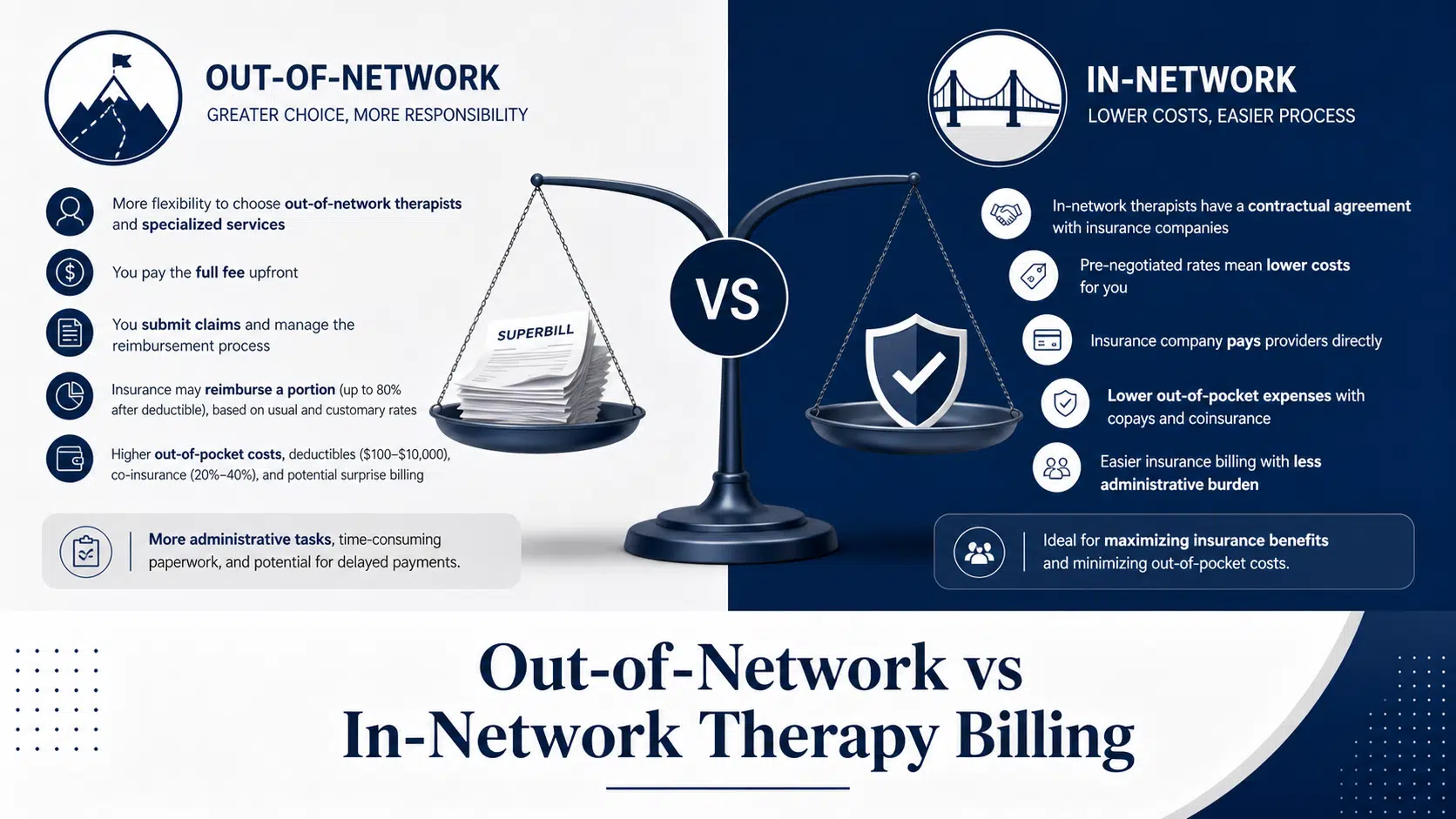
Out-of-Network vs In-Network Therapy Billing
10 min read
CPT Codes Behavioral Health: Cipher Billing’s Complete 2026 Guide Getting behavioral health billing right in 2026 requires precision. With denial rates for psychotherapy codes averaging 15-20% according to industry data, accurate CPT and HCPCS coding directly impacts your practice’s cash flow. At Ci
Cipher Admin
Cipher Billing Team

CPT Codes Behavioral Health: Cipher Billing’s Complete 2026 Guide Getting behavioral health billing right in 2026 requires precision. With denial rates for psychotherapy codes averaging 15-20% according to industry data, accurate CPT and HCPCS coding directly impacts your practice’s cash flow. At Ci
Getting behavioral health billing right in 2026 requires precision. With denial rates for psychotherapy codes averaging 15-20% according to industry data, accurate CPT and HCPCS coding directly impacts your practice’s cash flow. At Cipher Billing, we handle end-to-end coding, claim scrubbing, and denial management for behavioral health, addiction, detox, and residential providers nationwide. This guide walks you through the codes that matter most for calendar year 2026.
Accurate behavioral health CPT codes are mission-critical for reimbursement in 2026. Payers like Medicare, Medicaid, and commercial insurers scrutinize behavioral health claims more intensely than other specialties due to historical overutilization patterns. One coding error can delay payment by 60-90 days or trigger a denial that requires costly appeals.
Here are the most relied-on behavioral health codes for 2026:
Understanding the distinction between code sets is essential. CPT Level I codes (90xxx, 96xxx, 99xxx) are developed by the American Medical Association and universally recognized for professional services. HCPCS Level II codes (G-, H-, S-, T-codes) extend this for Medicare-specific services, state Medicaid variations, and commercial fillers. ICD-10 diagnosis codes (F01-F99 for mental disorders, Z00-Z99 for factors influencing health) justify medical necessity but are not billable services themselves.
This article is current for dates of service in calendar year 2026. Medicare, Medicaid, and commercial payer rules may vary by state and plan. Cipher Billing maintains payer-specific libraries to help providers navigate these variations.
CPT codes convert complex clinical encounters into reimbursable units. Every psychotherapy session, psychiatric evaluation, psychological test, and care management services activity must be translated into the correct CPT codes behavioral health payers recognize. Getting this translation right determines whether you get paid.
The three main behavioral health services families include:
These codes operate differently based on their structure:
Documentation principles apply across all behavioral health coding: establish medical necessity, record start/stop times for time-based services, note who was present, specify modality (in-person vs telehealth services), and provide clinical rationale. At Cipher Billing, we review provider documentation against CPT descriptors and payer policies before claims go out to reduce initial denials and later audits.
Most outpatient behavioral health revenue runs through the 90xxx psychiatry and psychotherapy codes. Accuracy here has the biggest impact on cash flow.
The psychiatric diagnostic evaluation codes establish the foundation for treatment:
Most payers restrict these to once per treatment episode. Repeating them without documenting a new episode (typically after six months without services) triggers denials.
These psychotherapy codes are strictly time-based:
The AMA’s exact thresholds require clear start/stop times in documentation. A 55-minute psychotherapy session only bills 90837 if you can prove the time. Audits frequently downcode 90837 to 90834 due to vague notes lacking behavioral descriptors of interventions and patient response.
Documentation must specify who attended, focus of treatment, relational dynamics, and relationship to the identified patient.
When prescribers provide both medication management and therapy to the same patient in one visit, a cpt add on code is used as a supplementary code alongside a primary CPT code to detail additional services or specific circumstances during a healthcare encounter:
These pair with E/M codes (99213, 99214, etc.) and require modifier 25 on the E/M code. Documentation must clearly separate medical decision making time for medication management from psychotherapy time.
Crisis codes address urgent, high-severity presentations:
Documentation must show an urgent, high-severity presentation requiring immediate, intensive interventions with imminent risk—not just a “difficult” session. Crisis services require proof of acute distress and safety planning.
Cipher Billing helps practices build templates aligned with these descriptors, reducing risk of downcoding and post-payment recoupments for frequently audited codes like 90837 and 90792.
Psychological, neuropsychological, and health behavior codes in the 96xxx series are often under-utilized or misused, leading to denial rates up to 25% from insufficient detail.
These cover integration of data, interpretation, clinical decision-making, and feedback by clinical psychologists or a qualified health care professional—not just face-to-face testing time. Examples include integrating MMPI-2 results for personality disorders or WAIS-IV for cognitive deficits post-TBI.
For neuropsychological test administration and scoring:
Document test names, raw scores, normative comparisons, and how results impact the treatment plan.
Common mental health CPT codes for screening include:
These apply to attention, mood, autism spectrum screening, and cognitive performance after injury.
These codes address health behaviors affecting physical conditions (e.g., anxiety impeding diabetes adherence) rather than primary psychiatric conditions. Use physical-health-related ICD-10 codes like E11.9 rather than primary psych codes.
Cipher Billing often sees payers deny 96xxx claims for insufficient detail. Document test names, time spent per activity, interpretation, and how results changed the care plan.
CMS’s behavioral health integration (BHI) and Collaborative Care Model (CoCM) families saw significant 2026 adoption growth, with reimbursement increases reflecting CMS’s push for integrating behavioral health into primary care. Care management services provided as part of behavioral health integration require comprehensive documentation, strict adherence to billing guidelines, and careful tracking of time and collaboration to ensure proper reimbursement.
Providers must avoid double billing for separate care management programs by ensuring that each 20-minute block of time is distinctly tracked and documented for BHI and CCM services.
These codes support behavioral health care planning without requiring a full collaborative care team.
CoCM codes require a structured primary care team approach:
The CoCM model requires:
A patient registry with measurement-based care (PHQ-9, GAD-7 tracking) is mandatory.
Cipher Billing helps practices track cumulative monthly minutes, map staff activities to the correct cpt code family, and avoid double-counting time that leads to denials.
HCPCS Level II codes—part of the Healthcare Common Procedure Coding System—fill critical gaps where CPT codes don’t apply. Understanding when to use these codes versus CPT is essential for detox, residential, and Medicaid services billing.
The common procedure coding system includes:
Many state Medicaid programs mandate H-codes for behavioral health and substance use disorder services:
Descriptions and reimbursement vary by state Medicaid manual. California, for example, requires ASAM criteria documentation for SUD services.
Not all payers accept S-codes—pre-contract review and benefits verification are critical.
Some states use T-codes for specialized behavioral health, waiver, or crisis services. Always check your state’s 2026 Medicaid fee schedule.
Cipher Billing maintains payer- and state-specific HCPCS libraries so detox, residential, and IOP programs use the correct H-, S-, or G-code rather than defaulting to an inapplicable CPT code that will deny.
Substance use and severe behavioral health programs rely heavily on HCPCS Level II plus select CPT codes. Incorrect coding is a top driver of denials we see at Cipher Billing.
Payers may require revenue codes and room/board components. Add physician E/M codes:
Group and individual psychotherapy within residential stays may be bundled into the per-diem or billable separately depending on payer. Confirm whether your payer treats services as bundled vs line-item billing.
Common combinations include:
Cipher Billing builds payer-specific billing playbooks for detox and residential programs, clarifying which services use per-diem HCPCS versus separate CPT codes.
In 2026, most psychotherapy services and BHI codes remain billable via telehealth, but coverage and modifier rules vary by payer and state.
Base CPT codes (90834, 90791, 99484) remain the same for telehealth vs in-person.
Confirm each payer’s 2026 POS instructions. Documentation must show telehealth modality, platform used, patient location, and consent when required.
Audio-only coverage has tightened post-public health emergency. Verify which codes your payer still covers for audio-only delivery.
Cipher Billing tracks telehealth rules by payer and advises clients when codes switch from temporary to permanent coverage.
Based on denial patterns from 2023-2025, here are the errors we see most frequently at Cipher Billing—and how to avoid them in 2026.
Cipher Billing performs pre-submission claim scrubbing and trend analysis on payer denials to correct recurrent errors at their source. We’ve seen practices reduce denial rates by 20% through systematic scrubbing.
Payers in 2026 increasingly tie payment to detailed, behaviorally specific documentation. High-value codes like 90837 and 90792 carry 10-15% recoupment risk when documentation falls short.
Every behavioral health note should include:
42 CFR Part 2 confidentiality requirements apply to SUD records and must be integrated into your documentation workflow.
Cipher Billing aligns provider templates, EHR smart phrases, and coding workflows with audit standards from Medicare, state Medicaid services, and major commercial plans.
Cipher Billing is a behavioral-health-focused RCM and coding partner that understands the nuances of 90xxx, 96xxx, 99xxx, and HCPCS Level II codes in 2026. We work exclusively with mental health practitioners, addiction treatment centers, and integrated care practices.
We monitor:
We translate updates into practical rule changes inside clearinghouses and billing software.
Consider a brief discovery call or claims audit with Cipher Billing. We’ll identify underused codes like 99484, 99492-99494, 96130-96139, and the most common CPT codes for your service mix. We’ll also pinpoint common denial drivers in your current workflow.
Accurate use of correct CPT codes and HCPCS codes in 2026 is both a compliance requirement and a powerful lever for stabilizing revenue. Whether you’re running an outpatient practice, a detox facility, or an integrated health care system, proper coding protects your bottom line and keeps your focus where it belongs—on patient care.
About the Author
Cipher Billing Team
In This Article
Cipher Billing specializes in behavioral health revenue cycle management. Reach out for a free consultation and see how we can maximize your reimbursements.