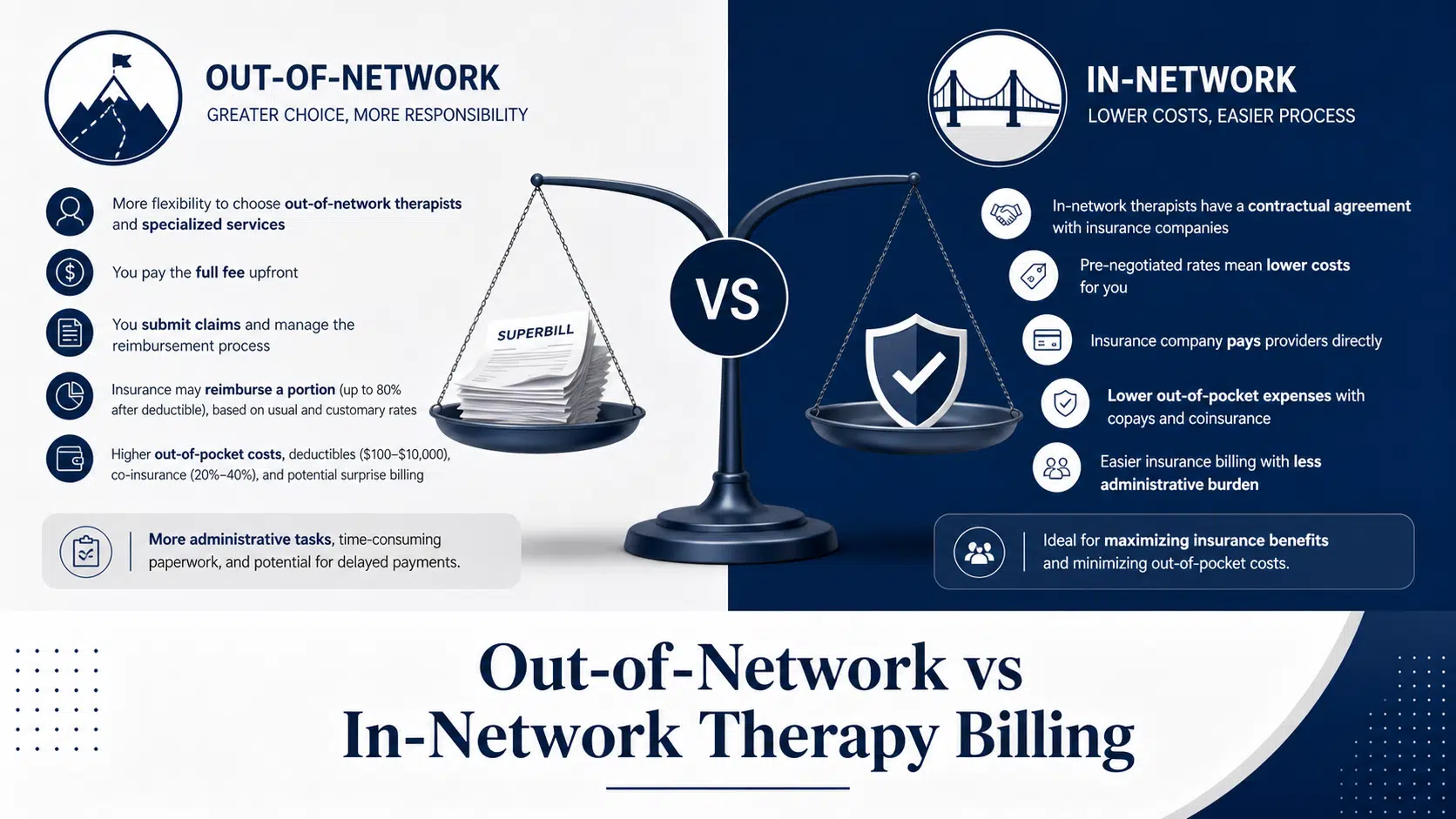
Out-of-Network vs In-Network Therapy Billing
10 min read
For behavioral health providers, few questions carry as much weight as this one: how long does mental health credentialing take? The answer determines when you can start seeing insured patients, when the first payment hits your account, and how quickly your practice can scale. At Cipher Billing, we&
Cipher Admin
Cipher Billing Team
For behavioral health providers, few questions carry as much weight as this one: how long does mental health credentialing take? The answer determines when you can start seeing insured patients, when the first payment hits your account, and how quickly your practice can scale. At Cipher Billing, we&
For behavioral health providers, few questions carry as much weight as this one: how long does mental health credentialing take? The answer determines when you can start seeing insured patients, when the first payment hits your account, and how quickly your practice can scale. At Cipher Billing, we’ve guided hundreds of mental health professionals through this maze since 2017, and we know exactly where the bottlenecks live. This comprehensive guide breaks down every stage of the credentialing process, realistic timelines, and proven strategies to accelerate approval with every insurance company you target.
Mental health credentialing is the formal verification process used by insurance carriers to confirm that a provider meets the professional and regulatory standards required to deliver care under their insurance plans. For behavioral health providers, it is the single most important administrative step between hanging out a shingle and actually getting paid by an insurance company.
Without proper credentialing, mental health providers can only rely on private-pay income, which dramatically limits patient access and revenue. Insurance credentialing opens the door to contracted reimbursement rates, broader referral networks, and long-term financial stability. It’s also the foundation of affordable quality healthcare — because when more mental health therapists accept insurance, more patients can access services they’d otherwise skip.
Credentialing helps prevent fraud, protects patient safety, and ensures only qualified healthcare professionals deliver care and collect insurance reimbursement. It’s a rigorous process — but one that pays dividends for the life of your practice.
Credentialing validates a provider’s qualifications, enabling mental health providers to bill insurance, which is essential for financial viability and practice growth. Effective credentialing is directly linked to improved patient access to care, because it allows providers to treat patients through insurance reimbursement rather than being capped at private pay. It’s not simply paperwork — it’s the gateway to sustainable mental health services.
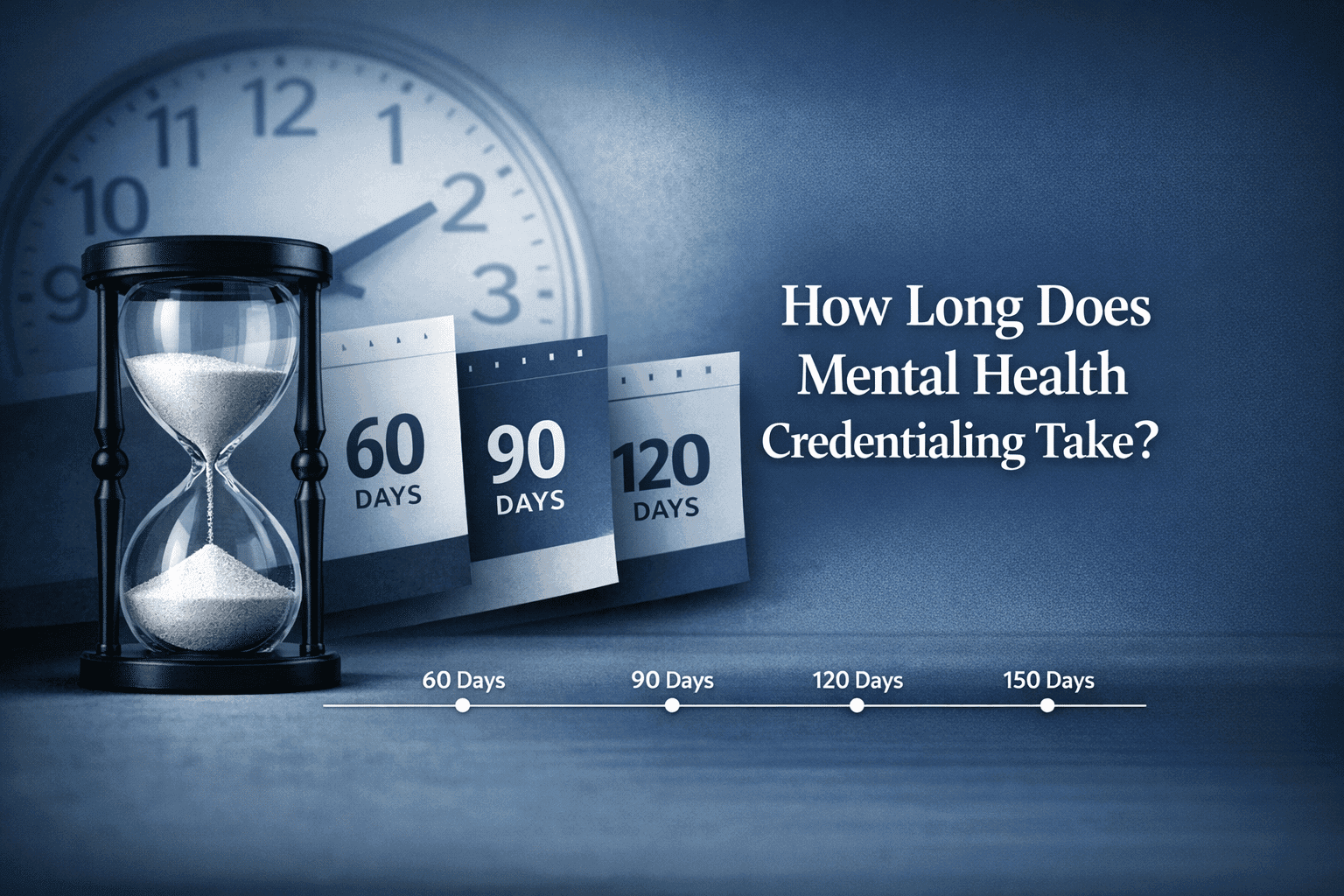
In the USA, mental health credentialing typically takes around 90 to 120 days (3–4 months), but it can extend to 180 days or more depending on documentation completeness, payer backlogs, and the specific insurance panels involved. Some straightforward cases wrap up in 60 days; others stretch past six months. Credentialing for mental health providers realistically ranges anywhere from 60 to 150 days depending on application accuracy and insurance company processing speed.
Here’s the hard truth: credentialing timelines are rarely under your full control. Insurance companies dictate much of the pace, and even a single missing signature on your credentialing applications can reset the clock. That’s why understanding each phase — and preparing documentation meticulously — is the smartest investment you can make before submitting anything.
The credentialing process moves through several distinct phases, each with its own expected duration:
The payer review stage — where the insurance company verifies credentials and passes your file to a credentialing committee — is historically the longest phase, typically consuming 60 to 120 days.
Understanding the full credentialing process helps you anticipate roadblocks and plan accordingly. Each step builds on the last, and skipping ahead almost always creates downstream delays.
Initial credentialing demands a thick stack of documents. Mental health providers should prepare:
Credentialing applications often require a detailed work history with zero gaps, and even minor omissions trigger delays or denials. Meticulous record-keeping is non-negotiable.
CAQH ProView is the centralized database that most insurance companies use for primary source verification. Providers must maintain an up-to-date CAQH profile — many insurance companies will not process credentialing applications until the CAQH profile is complete, current, and attested. Completing and attesting to a CAQH profile allows mental health professionals to share credentialing information with multiple insurers, drastically reducing the administrative burden of repetitive applications. Learn more about CAQH ProView standards here.
Once your CAQH profile is solid, submit applications to the insurance panels you want to join. Every insurance company has its own forms, supplemental questionnaires, and submission quirks. Commercial insurance carriers like Aetna, Cigna, and Blue Cross Blue Shield typically require separate provider enrollment packets even when your CAQH profile is already complete.
During the verification process, the insurance company contacts educational institutions, licensing boards, previous employers, and the National Practitioner Data Bank to confirm your credentials and check for disciplinary actions. This verification process is where many applications stall — delays can occur due to the verification speed of previous employers, educational institutions, or licensing boards. The National Practitioner Data Bank is a federal repository specifically designed for this purpose.
Your file is presented to the insurance company’s credentialing committee, which meets on fixed schedules (often monthly). They review the provider’s qualifications, confirm malpractice coverage, and issue credentialing approval or request additional information.
Credentialing must be completed before a provider can enter into insurance contracts with an insurance company. Contracting establishes your status as an in network provider, locks in reimbursement rates, and finalizes the terms under which you’ll bill insurance claims. This phase typically adds 1 to 3 weeks.
Different insurance panels move at very different speeds. Knowing what to expect helps you sequence applications strategically.
Medicare — the federal health insurance program — generally processes new provider enrollments in roughly 30 to 60 days after receiving a completed application, though errors or additional documentation requests can extend this to 60–90 days. Providers must use the PECOS online portal to enroll, selecting the appropriate form for individual practitioners or group practices.
Medicaid plans vary dramatically by state. Some states process provider enrollments in as little as a month; others take several months, especially when credentialing is outsourced to managed care organizations. Medicaid programs also impose state-specific requirements — background checks, site visits, and additional documentation are common.
Commercial insurers like Aetna and Blue Cross Blue Shield typically take 90 to 120+ days. Cigna, UnitedHealthcare, Humana, and regional plans land in similar territory. Private insurance panels can close to new providers entirely in saturated markets, so submitting early matters.
Incomplete applications are the single largest cause of delays in the credentialing process. Other frequent culprits include:
Credentialing can also be complicated by multi-state licensure requirements, particularly for telehealth. The American Medical Association offers helpful practice management guidance on navigating these complexities.
Credentialing applications require primary source verification of education, licensure, and disciplinary history. A single typo in your Tax ID or Employer Identification Number can bounce the entire file back. Expired malpractice insurance coverage triggers immediate rejection. Even a one-month gap in employment history without explanation can stall review for weeks.
While you can’t force an insurance company to move faster, you can eliminate every controllable delay. Here’s how Cipher accelerates credentialing for behavioral health providers:
Begin gathering documents and preparing your CAQH profile 3 to 6 months before you plan to see patients. New providers who start early routinely shave weeks off their go-live date.
Re-attest every 120 days. Upload current malpractice insurance, licenses, and board certifications the moment they renew. Many insurance companies pull directly from CAQH, so a stale profile equals a stalled application.
Contact each insurance company every 2–3 weeks to confirm there are no missing documents and that your application is progressing. Passive waiting is the enemy of fast credentialing approval.
Modern credentialing software tracks expiration dates, automates renewals, and flags missing items. Even better: outsourcing to professional credentialing services eliminates the learning curve entirely. Mental health therapists in private practice often find that outsourcing credentialing tasks frees them to focus on providing therapy services.
Errors are the #1 cause of delay. Verify your NPI, Tax ID, Employer Identification Number, license numbers, and malpractice policy numbers before submission. Quality assurance at the front end saves months on the back end.
Credentialing and contracting are often confused, but they’re distinct steps. Credentialing is the evaluation and verification of a provider’s qualifications. Contracting is the formal agreement that establishes the provider as an in network provider with an insurance company, including agreed-upon reimbursement rates. Credentialing must be completed first — without credentialing approval, no insurance contracts can be signed.
Credentialing isn’t one-and-done. Recredentialing is required every 2–3 years and typically takes 2–4 months. Healthcare organizations and treatment centers must maintain up-to-date credentialing files for each provider, including:
Conduct regular audits every 6–12 months to flag documents nearing expiration. Maintain a credentialing log for each provider listing every network they’re credentialed with, initial effective dates, and recredentialing due dates. This prevents lapses that can knock you off insurance panels and halt insurance reimbursement overnight.
Credentialing delays cost real money. While waiting for credentialing approval, mental health providers can’t accept insurance from that payer. Some insurance carriers allow retroactive billing to the application submission date — but many don’t. Every week of delay is a week of lost insurance reimbursement, which is why the financial considerations of credentialing timelines are so significant. Clinical social workers, mental health therapists, and nurse practitioners alike feel this pressure acutely when launching a new private practice.
Credentialing is also a compliance function. Proper credentialing protects your practice from fraud allegations, billing audits, and network termination. The National Committee for Quality Assurance sets many of the standards insurance carriers follow during credentialing. Staying aligned with NCQA standards — plus keeping disciplinary actions, license status, and malpractice coverage current — keeps your practice audit-ready.
At Cipher Billing, credentialing is one pillar of our broader mental health and substance use disorder treatment billing expertise. We’ve operated exclusively in denial prevention and behavioral health billing since 2017, which means we understand exactly how insurance payers evaluate mental health credentialing files — and exactly what makes them move faster.
Our performance speaks for itself: a 1.88% write-off rate, 92% of claims paid without compliance intervention, 96% first-pass medical record approval, 97% medical necessity appeal success, and 30-day timely first payments. For out-of-network facilities, we deliver a 30.36% average OON reimbursement through aggressive negotiation.
Cipher supports the full spectrum of behavioral health providers:
With average patient day rates of $1,821.49 inpatient and $1,149.38 outpatient, the financial stakes of fast, accurate credentialing are enormous.
Typically 90 to 120 days per insurance panel, though some applications close in 60 days and others stretch past 180.
You can see cash-pay patients. Some insurance companies allow retroactive billing from the application date once credentialing approval arrives — but this varies by payer.
Medicare often moves fastest (30–60 days). Commercial carriers and some Medicaid plans are slower.
Yes — every 2–3 years, and the process takes 2–4 months.
The question isn’t just how long does mental health credentialing take — it’s how much of that timeline you’re willing to leave to chance. With the right preparation, proactive follow-up, and an experienced partner, behavioral health providers can compress credentialing timelines, minimize administrative burden, and start billing insurance weeks ahead of schedule.
Cipher Billing delivers A Higher Level Partnership. If you’re launching a new practice, expanding insurance panels, or frustrated with stalled applications, let our team take the credentialing weight off your shoulders so you can focus on patient care.
Contact Cipher Billing today: Phone: (949) 368-0575 Email: info@cipherbilling.com Website: CipherBilling.com Office: 1665 Scenic Ave Suite 250, Costa Mesa, CA 92626 Hours: Monday–Friday, 8:00 AM – 5:30 PM PST
About the Author
Cipher Billing Team
In This Article
Cipher Billing specializes in behavioral health revenue cycle management. Reach out for a free consultation and see how we can maximize your reimbursements.