
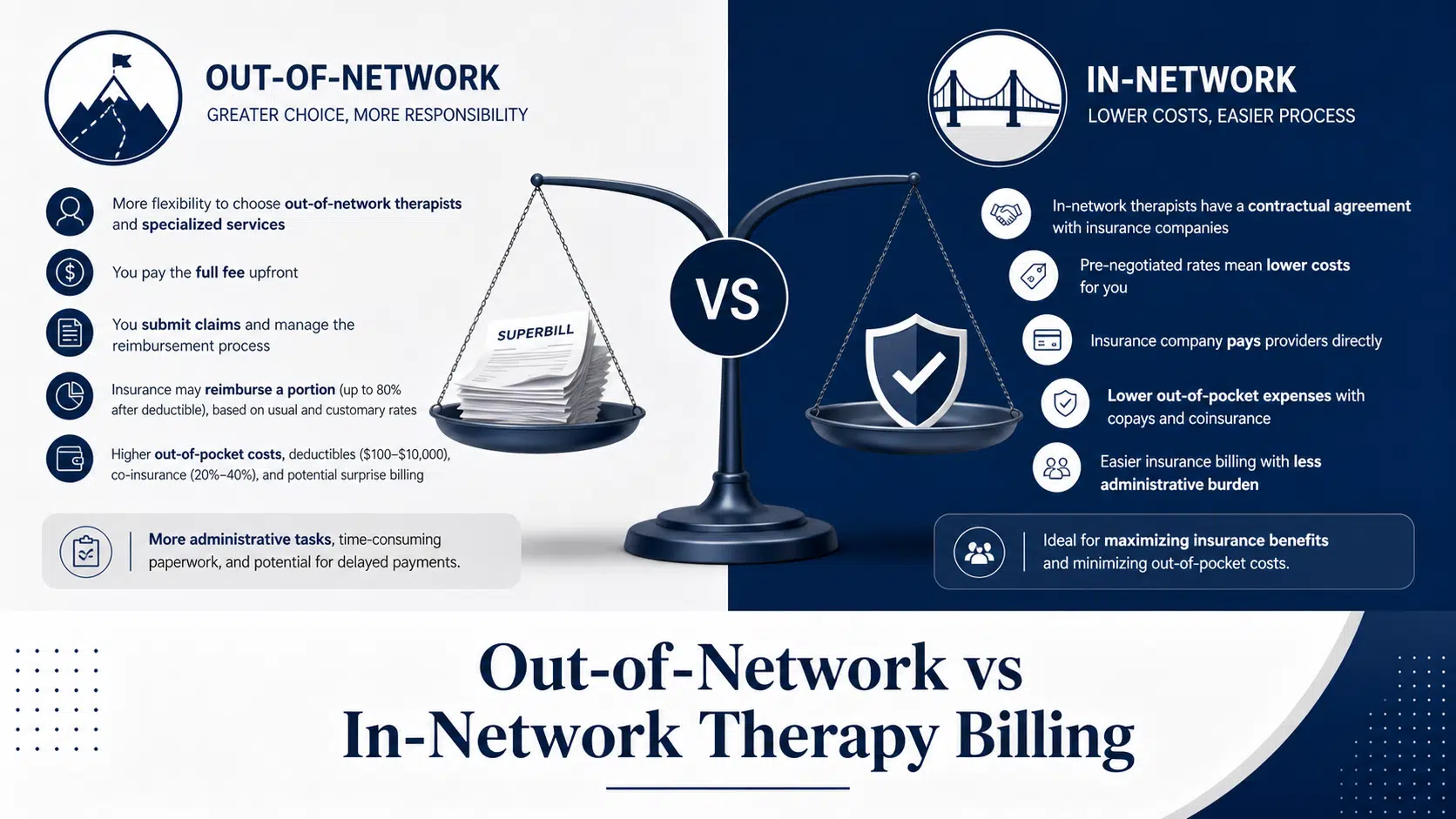
Out-of-Network vs In-Network Therapy Billing
10 min read
Opening a new behavioral health program or bringing on a new psychiatrist? The question every facility administrator asks is simple: how long does credentialing take before we can actually bill for services? The answer shapes your hiring timeline, your cash flow projections, and your sanity. This gu
Cipher Admin
Cipher Billing Team
Opening a new behavioral health program or bringing on a new psychiatrist? The question every facility administrator asks is simple: how long does credentialing take before we can actually bill for services? The answer shapes your hiring timeline, your cash flow projections, and your sanity. This gu
Opening a new behavioral health program or bringing on a new psychiatrist? The question every facility administrator asks is simple: how long does credentialing take before we can actually bill for services? The answer shapes your hiring timeline, your cash flow projections, and your sanity.
This guide breaks down realistic credentialing timelines for mental health and addiction treatment facilities, explains what drives delays, and shows how partnering with a specialized billing team like Cipher Billing can help you start generating revenue faster once your providers are approved.
Provider credentialing in behavioral health is the verification process that confirms a clinician’s qualifications before they can treat patients and bill insurance payers. For RTCs, PHPs, IOPs, and outpatient mental health clinics, this step is non-negotiable.
Healthcare credentialing is complex and time-consuming, often taking 90 to 120 days, but it can range from as little as 30 days to more than six months. The credentialing process verifies education, licensure, malpractice insurance history, employment history, board certification, and any disciplinary actions or sanctions before healthcare professionals can participate in insurance panels.
For behavioral health specifically, credentialing is required by commercial payers, Medicare and Medicaid, and many referral partners. At a high level, credentialing verifies qualifications, payer enrollment links providers to insurance networks for claims payment, and privileging grants facility-level approval for specific services.
Every day a therapist, psychiatrist, or nurse practitioner cannot be billed represents direct lost income for your facility—particularly painful when you’re covering payroll for a provider who’s already treating patients.
Credentialing can take anywhere from 60 to 180 days, with 90 to 120 days being a common timeframe for initial credentialing. Credentialing timelines vary significantly by type of organization and specialty, with solo providers typically moving through the process faster than group practices or facilities handling higher-risk cases.
Typical timeframes by category:
Approximate ranges by setting:
Average payer timelines:
When a clinician is joining multiple insurance networks simultaneously, timelines are cumulative even when applications run in parallel. Most insurance companies process independently, so plan accordingly.
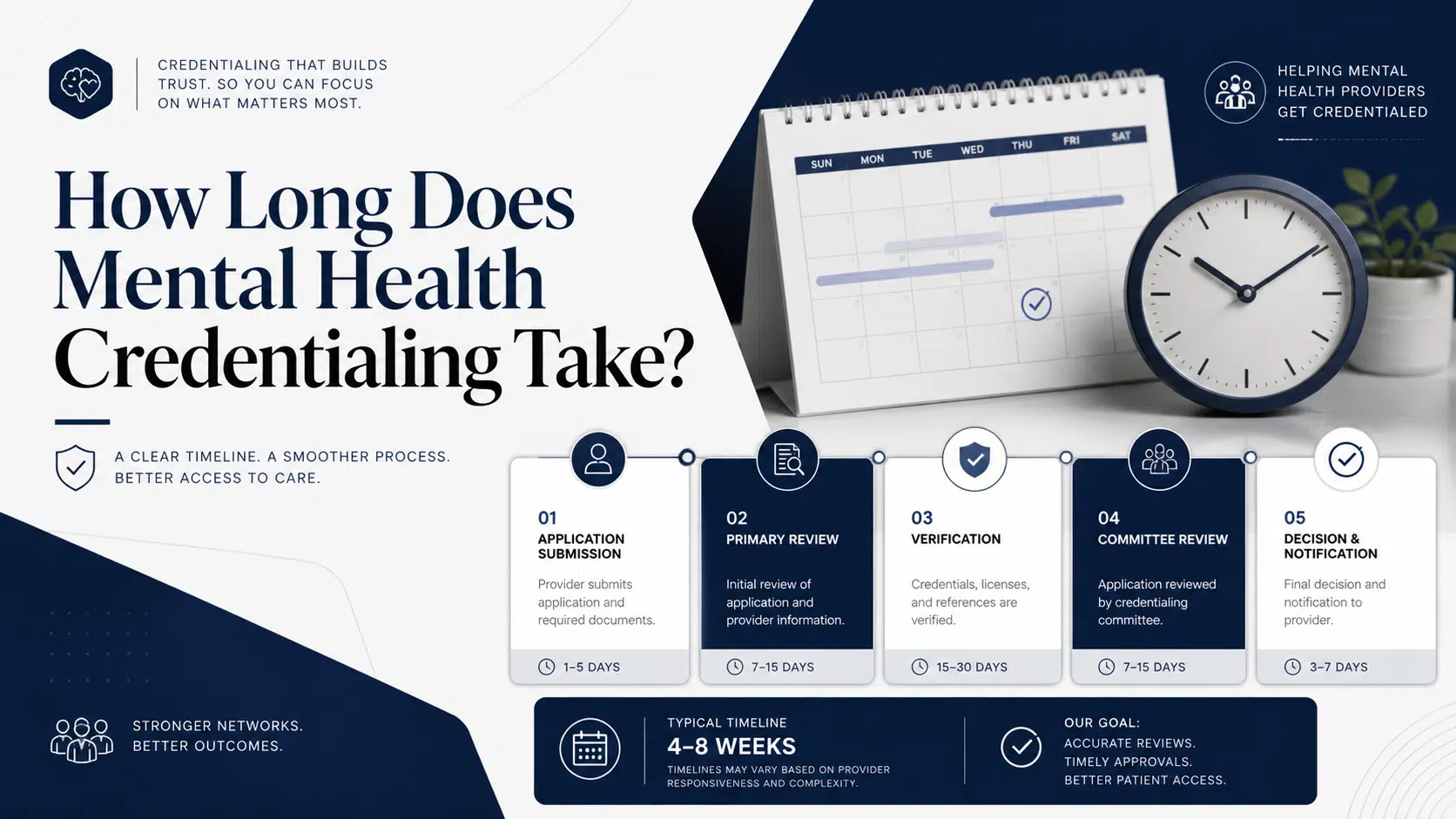
The credentialing process generally follows a standardized timeline influenced by multiple factors, such as application completeness and third-party efficiency. While forms and portals differ across payers, the core steps remain consistent.
Main credentialing steps:
For behavioral health, utilization review readiness—including treatment plan templates and documentation standards—needs alignment during credentialing to prevent post-approval payment issues.
After submitting the application, proactive follow-up is crucial to identify and rectify any errors or omissions, which helps avoid unnecessary delays in the credentialing process. Recredentialing follows the same steps but moves faster when data has been kept current.
Most credentialing delays stem from a combination of provider-side issues, payer rules, and internal processes—not just slow insurance companies.
Major delay factors:
For behavioral health specifically, delays often tie to multiple practice locations, telehealth versus brick-and-mortar address discrepancies, and out-of-network contract negotiations. An application with missing or incorrect information like malpractice carrier details can add three to four weeks of back-and-forth emails.
Typical credentialing timelines look different depending on provider type and facility model.
Professionals are advised to begin the credentialing process 4 to 6 months before their expected start dates to avoid delays. Start credentialing as soon as a signed offer letter or LOI is in place—not at the clinician’s planned start date.
Cipher Billing operates as a behavioral-health-only billing and RCM partner, integrating with your facility’s existing credentialing processes rather than replacing them. Our focus is ensuring that once your providers are credentialed, revenue flows immediately.
How Cipher supports faster revenue:
This approach means fewer denials and faster payments, reducing the cash flow pain of long credentialing windows.
You cannot control every payer’s backlog, but you can remove most preventable delays through better internal processes.
Standardizing the onboarding procedures ensures that every healthcare provider follows a consistent path from hiring to credentialing, which helps reduce errors and maintain accuracy during the process.
Small, preventable mistakes often cause the biggest costly delays. Inaccuracies in submitted documents often lead to repeated follow-ups and requests for additional documentation, which can extend the credentialing timeline by weeks or even months.
Typical pitfalls and fixes:
Conduct internal pre-submission reviews or mini-audits before any packet goes to payers. This mirrors Cipher’s audit-based approach and catches errors before they cause common delays.
Many healthcare facilities lump these steps together, but each has its own timeline and owners.
Even if credentialing is completed in 60 to 90 days, payer enrollment and privileging can add another 30 to 60 days before the healthcare provider can see reimbursable patients.
Behavioral health facilities should map these phases on a simple timeline for each new hire to set realistic start and revenue expectations. Cipher’s billing team confirms effective dates and network status before go-live to ensure first claims are clean and payable.
Recredentialing is not a one-time event but a repeating cycle driven by payer and accreditation rules. Recredentialing, which occurs every two to three years, generally takes between 60 to 120 days for most providers.
The credentialing duration shortens significantly when provider data has been continuously maintained and tracked. Primary source verification is a key factor that dictates time required, as it involves fact-checking with original sources.
Lapses in recredentialing can freeze a provider’s ability to bill even while they continue seeing patients—creating retroactive denials and revenue clawbacks. Use calendar reminders, credentialing software, or RCM partners to monitor recredentialing dates for every clinician and location.
Implementing credentialing software can significantly speed up the process by automating repetitive tasks such as document collection and tracking license expirations, thereby reducing manual errors and improving collaboration among credentialing teams.
Earlier collaboration usually means shorter delays and faster first payments once the application process completes.
Ideal entry points:
Cipher reviews payer mix, helps prioritize which networks to pursue first, and aligns documentation to prevent post-credentialing denials. Because we maintain a 100% pre and post-payment review rate and a 1.88% write-off rate, facilities get faster payments and cleaner long-term revenue once providers are fully credentialed.
Contact Cipher Billing at (949) 368-0575 or info@cipherbilling.com for a credentialing and billing readiness discussion tailored to your program.
These questions address practical concerns not fully covered above, with direct answers for behavioral health facilities navigating credentialing.
Providers can typically see cash-pay or self-pay patients earlier, but cannot bill most insurance companies until credentialing and payer enrollment are finalized. Some facilities hold claims and bill retroactively once effective dates are assigned, but this carries risk and requires payer-specific approval. Consult with a billing partner like Cipher Billing before adopting any retroactive-billing strategy to avoid unnecessary delays and compliance issues.
States like Texas require standardized applications, additional qualification checks, and sometimes committee review, extending timelines toward 150 to 180 days. State-specific prescriptive authority rules, background checks including criminal records screening, and licensing boards processing backlogs contribute to longer waits. Facilities expanding into slower states should start credentialing several months before anticipated go-live dates to ensure patient safety standards are met.
Closed insurance panels are common in certain markets, but exceptions can sometimes be negotiated with strong data on local access needs and specialized credentialing services. Engage experienced negotiators or RCM partners who can present utilization, outcome, and access arguments to payers. Diversify your payer mix, consider out-of-network strategies where appropriate, and revisit panel status every few months.
For a small to mid-size behavioral health facility, credentialing can consume 10 to 20 hours of internal team time per provider over several months. This includes document chasing, application completion, portal logins, and repeated follow-ups with payers and licensing boards. Outsourcing tasks to specialized billing and RCM teams frees internal staff to focus on admissions, clinical operations, and patient care.
Without credentialed and enrolled providers, healthcare organizations may have high census but minimal reimbursable revenue for the first 60 to 120 days. This gap creates serious cash-flow stress for new RTC, PHP, or IOP programs, especially when payroll and housing costs start immediately. Planning credentialing early and coordinating with a partner like Cipher Billing shortens the time from first admission to first payment, stabilizing cash flow and ensuring healthcare facilities can deliver faster credentialing outcomes through the healthcare industry’s standard approval procedures.
About the Author
Cipher Billing Team
In This Article
Cipher Billing specializes in behavioral health revenue cycle management. Reach out for a free consultation and see how we can maximize your reimbursements.