
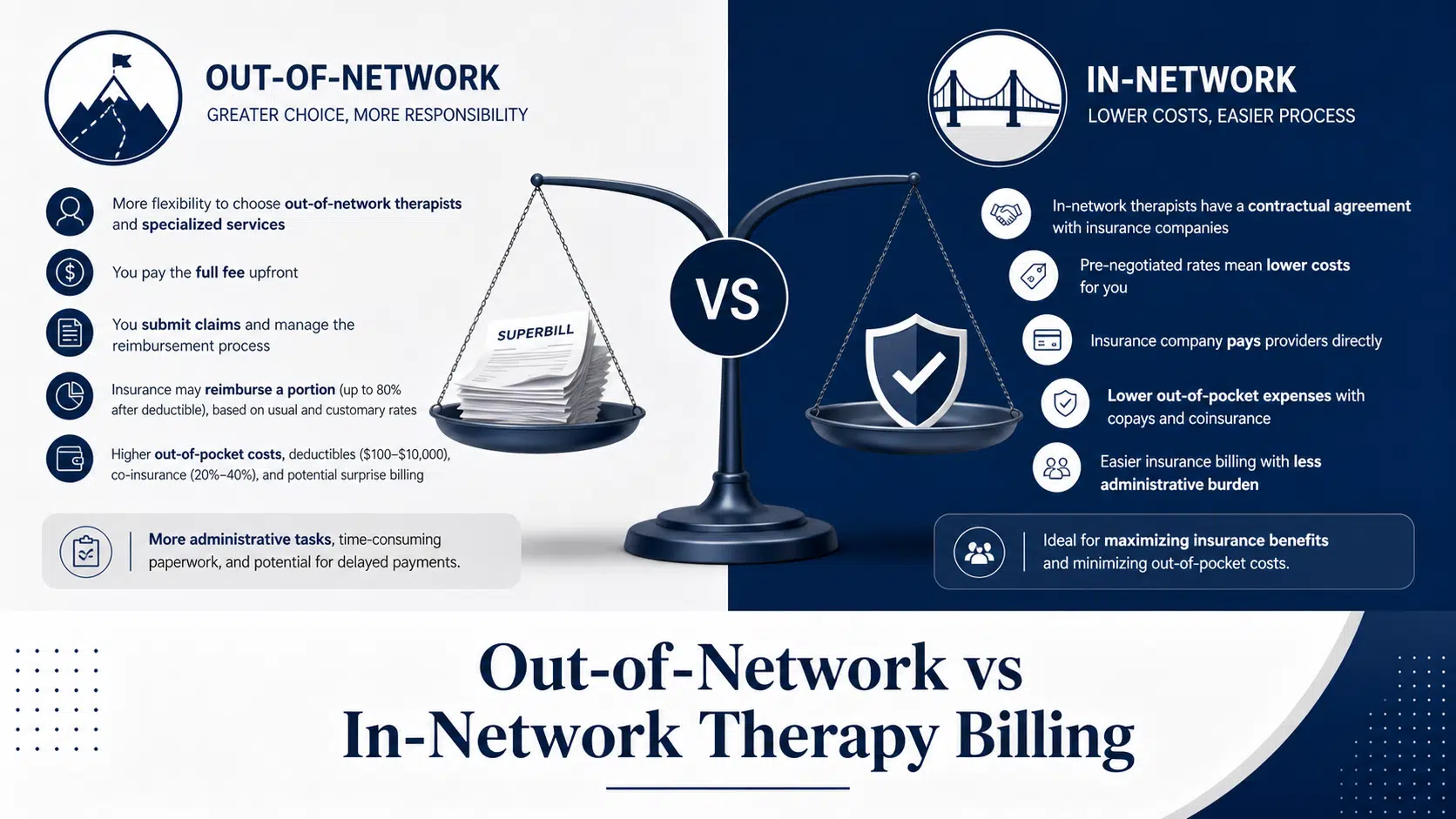
Out-of-Network vs In-Network Therapy Billing
10 min read
In behavioral health, the difference between a thriving facility and one bleeding cash isn’t always clinical excellence—it’s operational consistency. When your billing process changes depending on who’s working that day, which payer is calling, or how busy your front office is, rev
Cipher Admin
Cipher Billing Team
In behavioral health, the difference between a thriving facility and one bleeding cash isn’t always clinical excellence—it’s operational consistency. When your billing process changes depending on who’s working that day, which payer is calling, or how busy your front office is, rev
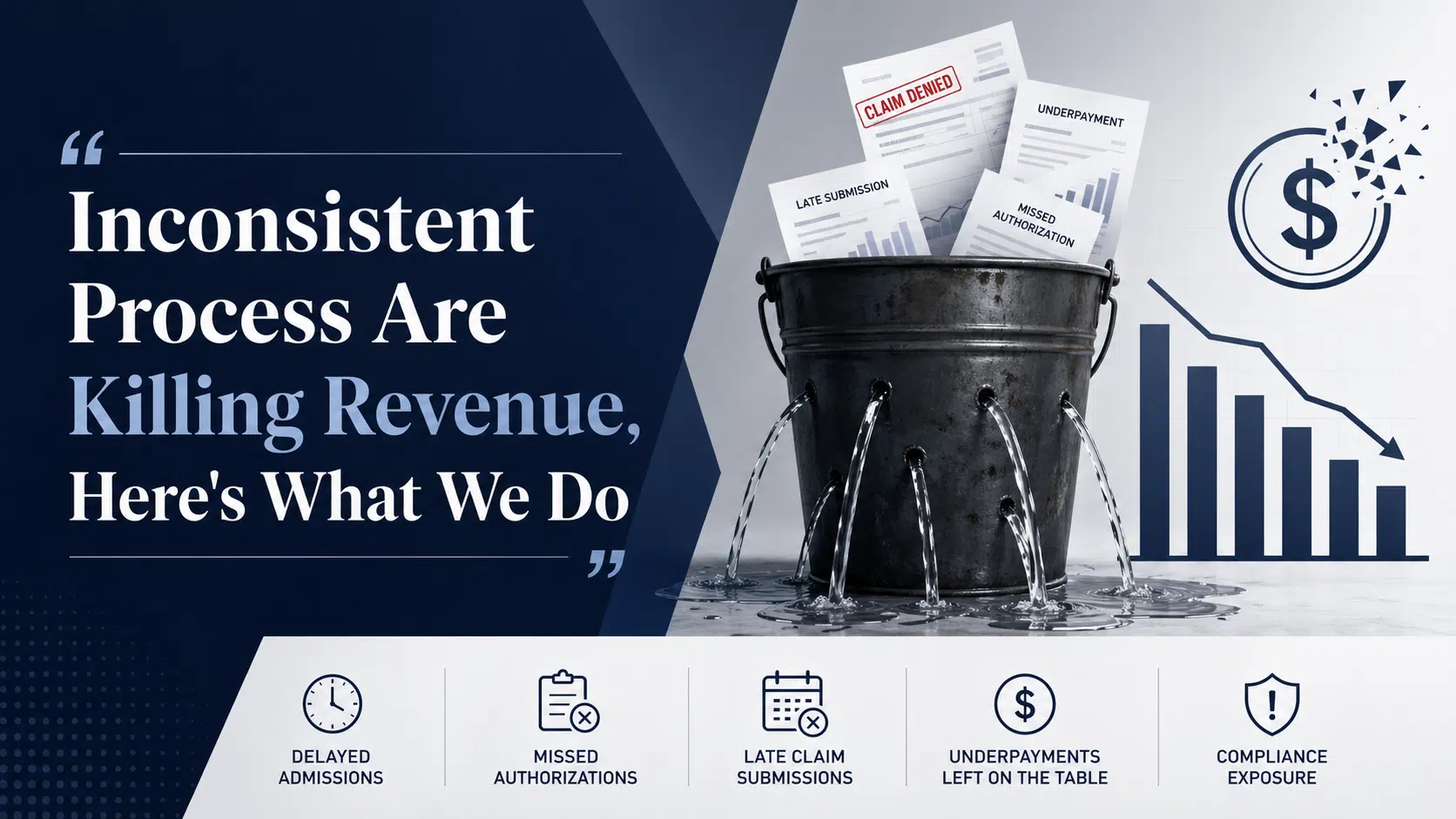
In behavioral health, the difference between a thriving facility and one bleeding cash isn’t always clinical excellence—it’s operational consistency. When your billing process changes depending on who’s working that day, which payer is calling, or how busy your front office is, revenue slips through the cracks faster than you can track it. Inconsistent processes are killing revenue at addiction treatment centers, mental health clinics, and residential facilities across the country, and most owners don’t realize how much money they’re leaving on the table until it’s too late.
At Cipher Billing, we’ve spent years exclusively inside the behavioral health revenue cycle, and we see the same pattern repeat itself: facilities with strong clinical outcomes losing six and seven figures a year because their back-office workflows are reactive instead of systematic. Here’s exactly why that happens—and what we do to fix it.
Behavioral health billing is uniquely complex. Between fluctuating levels of care, medical necessity documentation, utilization review timelines, and out-of-network negotiations, there are dozens of touchpoints where a single dropped step can cost thousands of dollars per patient. According to the American Medical Association, claim denials and rework cost the U.S. healthcare system billions annually, and behavioral health providers carry an outsized portion of that burden due to specialized coding requirements.
The core problem isn’t usually skill. It’s variability. When your VOB process takes 8 minutes one day and 45 minutes the next, when claim submission happens “when we get to it,” when denials sit in a folder for two weeks before someone responds—you’ve created a leaking bucket. And no amount of patient volume will fill a bucket that isn’t sealed.
The Substance Abuse and Mental Health Services Administration consistently emphasizes that operational stability is foundational to sustainable care delivery. You cannot deliver consistent clinical outcomes on top of an inconsistent revenue foundation.
When we audit a new prospective partner, we almost always uncover the same red flags:
Each of these gaps is survivable on its own. Stacked together, they compound into a revenue cycle that can lose 20–40% of collectible dollars without anyone seeing the line item.
Cipher operates exclusively in behavioral health denial prevention and revenue cycle management. We don’t bill for cardiology, dermatology, or general practice. That focus is the reason our processes are tighter than generalist billing companies, and it’s the reason we deliver the metrics our partners rely on.
We don’t take over a facility’s billing and start submitting. We start with a comprehensive prospective audit of your documentation, coding, and clinical-to-billing handoff. We identify compliance risks before they become denials. The HHS Office of Inspector General has published extensive compliance guidance for healthcare providers, and our audit framework is built to align with those expectations from day one.
Industry standard for VOB turnaround is roughly 30 minutes. Cipher delivers full eligibility, cost-share, historical data, and out-of-network benefit details in 8 to 9 minutes. That speed is not an accident—it’s the result of a fixed, repeatable workflow that runs the same way every single time, regardless of who’s on shift. Faster VOBs mean faster admissions, and faster admissions mean lives saved and beds filled.
Claims are submitted the same day, every day. Our coding team is trained exclusively on behavioral health CPT and ICD-10 combinations, which is why we maintain a 96% first-pass medical record approval rate and a 92% paid-without-compliance-intervention rate.
Our UR team communicates with payers daily to secure authorizations, extend patient stays when clinically warranted, and defend medical necessity in real time. This is where most facilities lose the most money silently—and where consistency pays the largest dividend.
Every denial gets a root-cause analysis within 24 hours. We don’t accept “no” as a final answer. Our medical necessity appeal success rate sits at 97%, and when payers refuse to play fair, we escalate to state insurance commissioners. The National Association of Insurance Commissioners provides clear pathways for provider escalations, and we use them when warranted.
Every payment is reviewed. Every remittance is analyzed. Underpayments are identified and pursued. This is how we keep our write-off rate at 1.88%—a number that’s almost unheard of in behavioral health, where industry write-offs commonly run into double digits.
We average 30.36% out-of-network reimbursement through structured negotiation tactics, not passive acceptance. Inpatient day rates average $1,821.49 and outpatient rates average $1,149.38 across our partner facilities.
Process consistency only works when humans are accountable. That’s why every Cipher partner is assigned a dedicated, U.S.-based Partner Experience Executive—not a ticket queue, not an offshore call center. You know who’s handling your account, and they know your facility inside and out.
We’re EHR-agnostic, working seamlessly inside Kipu, Avea, Sunwave, ZenCharts, and other platforms your clinical team already uses. No software changes. No re-training. Just a tighter back office. The Office of the National Coordinator for Health IT consistently advocates for interoperability that doesn’t disrupt clinical workflows—and that’s exactly the model we operate under.
These aren’t aspirational numbers. They’re the byproduct of refusing to let any step in the revenue cycle happen “however it happens today.”
If your facility is experiencing inconsistent VOB times, sporadic denial follow-up, write-offs you can’t explain, or out-of-network reimbursements that feel arbitrary, the issue isn’t your team’s effort—it’s your system. Cipher Billing builds the system, runs the system, and defends the revenue the system produces, so your clinical staff can focus strictly on patient care.
Reach out to schedule a prospective audit and see exactly where revenue is leaking inside your current process.
A Higher Level Partnership starts with a higher level of consistency. Let’s build it together.
About the Author
Cipher Billing Team
In This Article
Cipher Billing specializes in behavioral health revenue cycle management. Reach out for a free consultation and see how we can maximize your reimbursements.