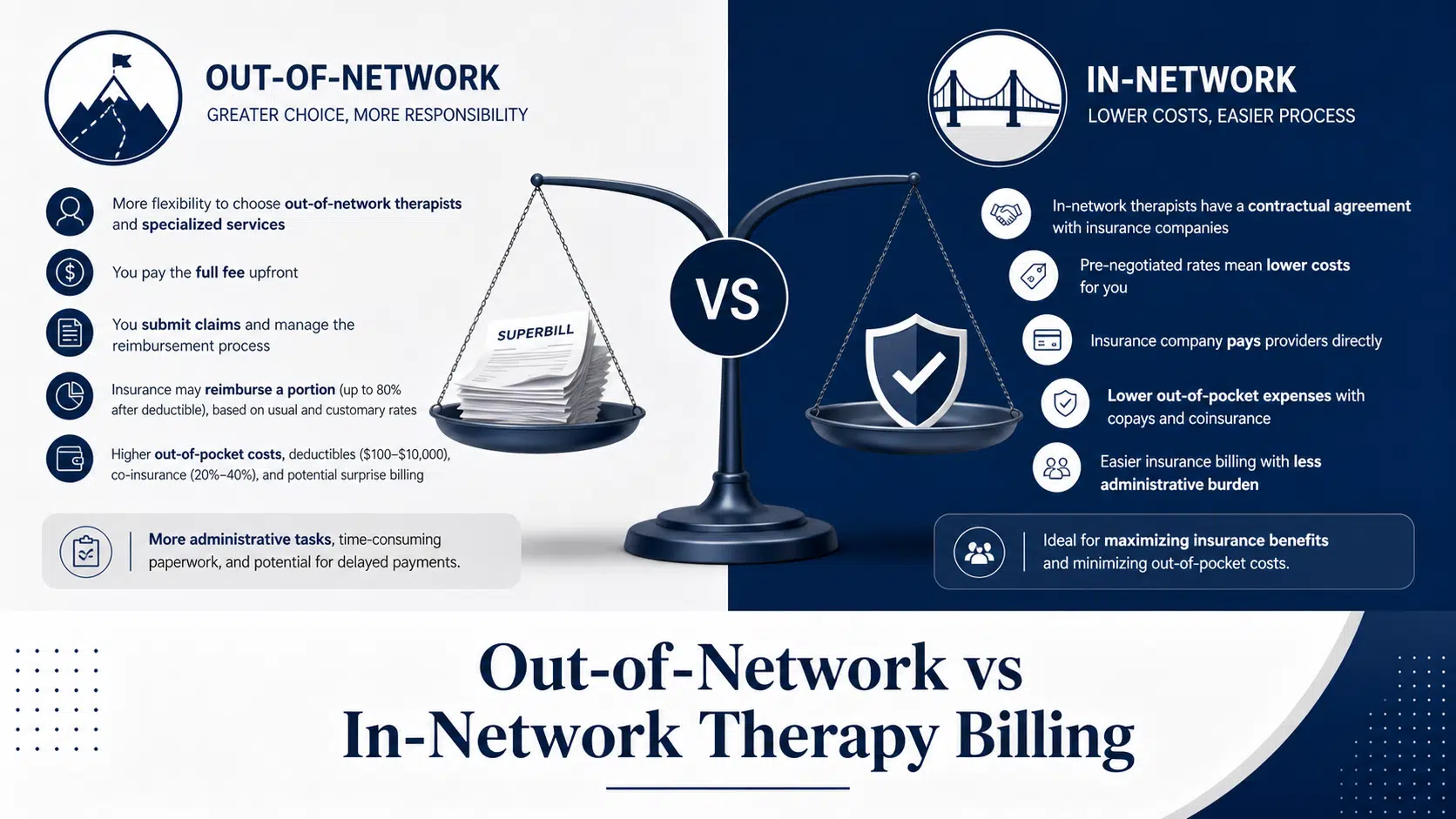
Out-of-Network vs In-Network Therapy Billing
10 min read
CPT code 99408 is used for structured screening and brief intervention services for alcohol and/or substance abuse that last between 15 and 30 minutes. Getting this code right in substance use disorder settings directly impacts your facility’s revenue and compliance posture. Here’s what behavioral h
Cipher Admin
Cipher Billing Team
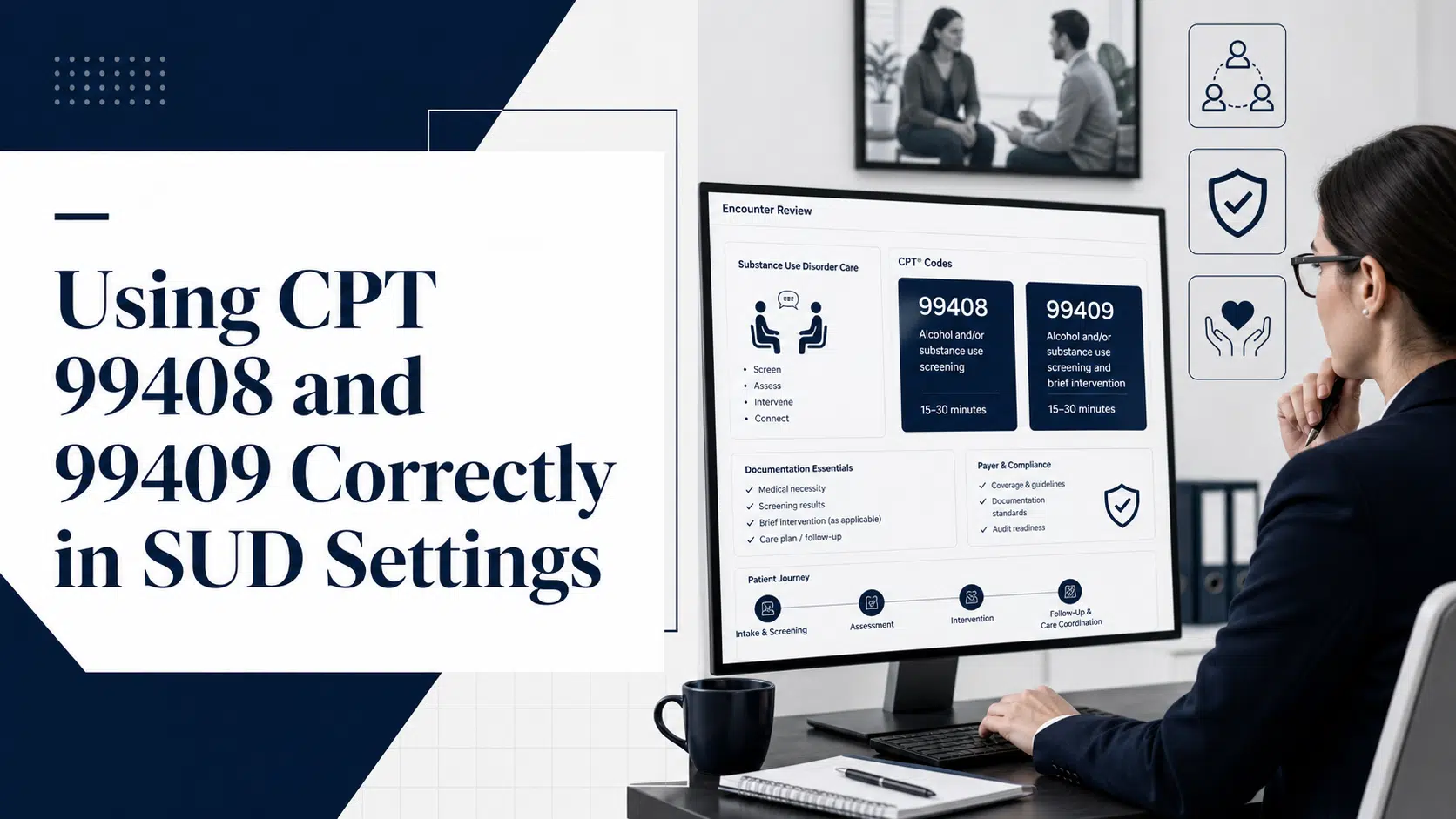
CPT code 99408 is used for structured screening and brief intervention services for alcohol and/or substance abuse that last between 15 and 30 minutes. Getting this code right in substance use disorder settings directly impacts your facility’s revenue and compliance posture. Here’s what behavioral h
CPT code 99408 is used for structured screening and brief intervention services for alcohol and/or substance abuse that last between 15 and 30 minutes. Getting this code right in substance use disorder settings directly impacts your facility’s revenue and compliance posture. Here’s what behavioral health billing teams need to know.
The official 99408 CPT description reads: “Alcohol and/or substance (other than tobacco) abuse structured screening and brief intervention services; 15 to 30 minutes.” This cpt code applies when providers administer a validated screening tool and deliver evidence-based intervention in the same encounter.
Key distinctions:
Typical scenarios include a 20-minute session after a positive Alcohol Use Disorders Identification Test during primary care or a 25-minute substance use assessment during behavioral health intake.
SBIRT (Screening, Brief Intervention, and Referral to Treatment) is a population health strategy designed to identify substance use disorders and those at risk, enabling early intervention and prevention. The code encompasses a specific clinical workflow that includes structured screening using validated instruments, brief intervention based on screening results, and referral to treatment if necessary.
The SBIRT process includes three main components:
Component
Description
Screening
Using validated tools like the AUDIT, drug abuse screening test (DAST), CAGE questionnaire, NIDA Quick Screen, or substance involvement screening test (ASSIST)
Brief Intervention
Short conversation using motivational interviewing techniques to increase awareness of substance use risk and set goals
Referral to Treatment
Discussing specialized treatment options for patients with severe issues
The SBIRT process, which CPT 99408 supports, is designed for the early identification and intervention of substance use disorders, making it a critical tool in both behavioral health and mental health settings. Brief intervention includes a short conversation to increase the patient’s awareness of their substance use risks and set goals using motivational interviewing techniques.
CPT code 99408 is applicable in various healthcare settings, including behavioral health treatment centers, primary care integrated settings, emergency departments, annual wellness visits, outpatient counseling practices, and residential treatment programs.
Appropriate service locations include:
CPT 99408 can be billed during new patient intakes when substance use screening and brief intervention take place as part of the intake process, provided the service lasts between 15 and 30 minutes. The key requirement is that SBIRT time is clearly distinguishable from other billed services on the same date.
Cipher Billing helps facilities map 99408 to clinical workflows, integrating SBIRT into admission nursing assessments without double-counting time spent against evaluation and management codes.
Documentation for SBIRT services billed under CPT 99408 must include the specific validated screening instrument used, the patient’s risk level classification, the content of the brief intervention, and the total time spent on the service, which must be between 15 and 30 minutes.
Required documentation elements:
Cipher Billing runs prospective documentation audits before claims submission, catching gaps that would trigger denials on codes like 99408.
Coverage for 99408 varies by payer. Cipher Billing routinely verifies SBIRT coverage during its rapid VOB process, delivering eligibility data in 8–9 minutes versus the industry standard of 30.
Medicare, Medicaid, and commercial payer considerations:
Common pitfalls that trigger denials:
Correct pairing of 99408 with related codes and modifiers prevents recoupments and audit issues.
Similar codes to CPT 99408 include CPT 99409 for sessions lasting over 30 minutes and HCPCS codes G0396 and G0397 for Medicare. CPT 99408 typically requires a separate claim submission using modifier 25 if billed on the same day as an Evaluation and Management (E/M) service.
Key modifier usage:
Modifier
Purpose
25
Significant, separately identifiable E/M service same date
33
Preventive service—waives patient cost-sharing
95
Live telehealth encounter where policy permits
Services under 15 minutes do not qualify for 99408 and should not be reported with modifier 52. Instead, document screening only or incorporate into E/M. Cipher Billing configures EHR charge capture so telehealth SBIRT encounters automatically apply correct modifiers.
SBIRT billing draws payer audit attention because it’s time-based, preventive, and often high-volume in addiction treatment settings.
Common compliance failures:
Cipher Billing’s audit-based onboarding reviews existing SBIRT documentation, templates, and charge flows to flag risk before claims go out. Performance metrics demonstrate results: 96% first-pass medical record approval, 1.88% write-off rate, and 97% medical necessity appeal success.
Eligible providers for CPT 99408 include physicians, physician assistants, nurse practitioners, and qualified behavioral health providers. Facilities should confirm each payer’s credentialing requirements before allowing mid-level staff to report this code.
Most Medicare and commercial plans allow 99408 once per year per patient as a preventive service. Additional sessions require strong documentation of medical necessity and payer policy confirmation. State Medicaid programs vary, so always verify current limits rather than assuming annual caps.
Most payers expect a positive or at-risk screening result plus documented brief intervention to justify 99408. A purely negative screen without counseling is generally not billable. Basic substance use questions during an E/M visit are typically considered part of that evaluation rather than separately billable SBIRT.
Eligible providers for CPT 99408 include physicians, physician assistants, nurse practitioners, and qualified behavioral health providers. Some states allow licensed clinical social workers or counselors depending on payer credentialing rules. Always confirm requirements before having non-physician staff report this code.
No. CPT 99408 is defined as an individual, face-to-face service. If SBIRT principles are applied in group therapy, different group psychotherapy or education codes may apply. One-on-one SBIRT delivered before or after a group session can potentially qualify if it meets time and content criteria with separate documentation.
Cipher Billing performs pre-implementation audits of SBIRT workflows, configures payer-specific rules in your EHR, and trains staff on time tracking and documentation templates. Combined with rapid VOB, aggressive denial management, and 97% appeal success rates, facilities see reduced write-offs and maximized approved reimbursement for SBIRT services. Contact Cipher at (949) 368-0575 to discuss your billing needs.
About the Author
Cipher Billing Team
In This Article
Cipher Billing specializes in behavioral health revenue cycle management. Reach out for a free consultation and see how we can maximize your reimbursements.