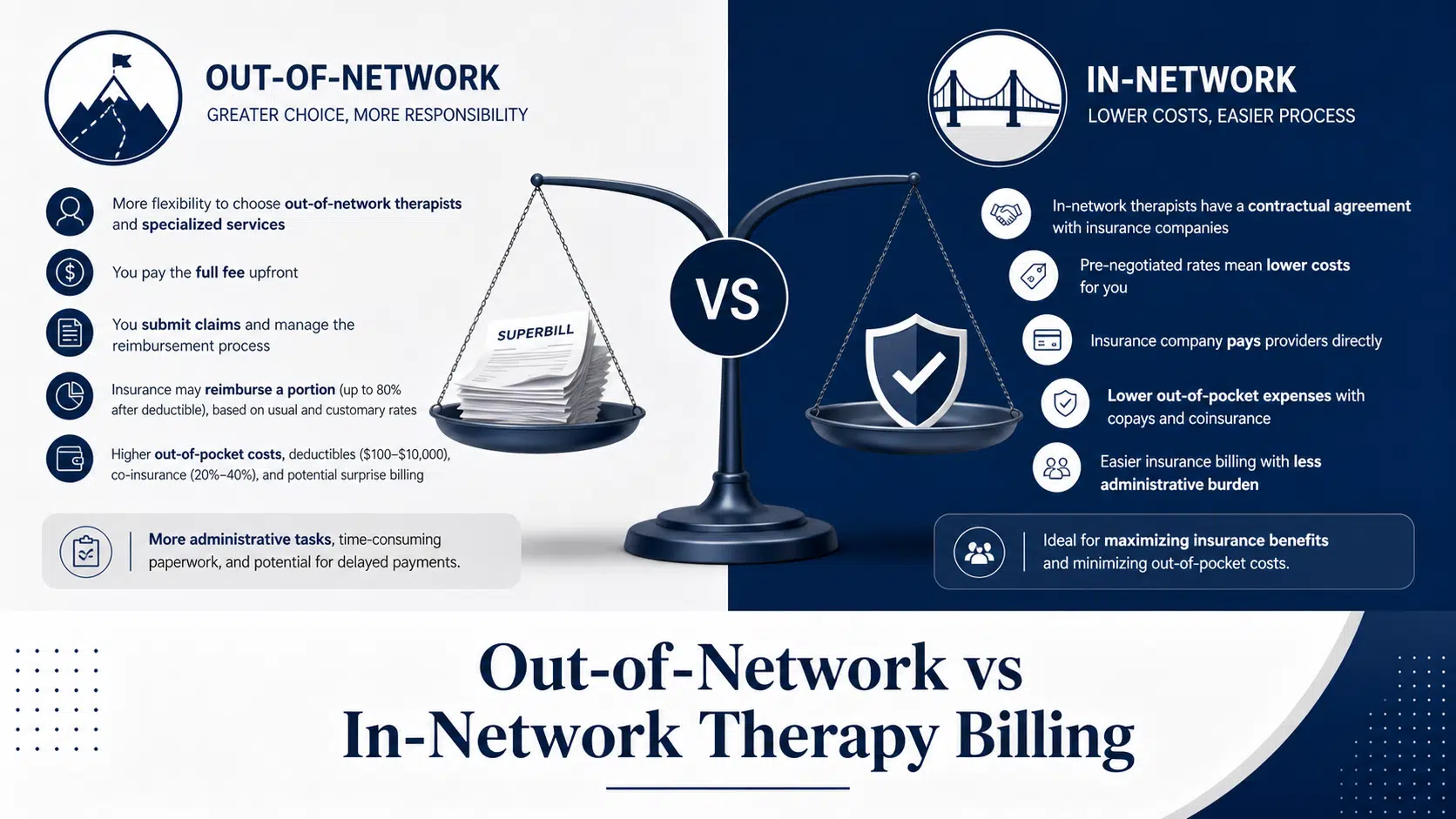
Out-of-Network vs In-Network Therapy Billing
10 min read
Verification of Benefits for Behavioral Health: Why Are VOB’s Important Key Takeaways Verifying behavioral health benefits 3–5 business days before the first appointment is the fastest way to prevent denials and surprise patient balances. Most facilities that prioritize accurate insurance veri
Cipher Admin
Cipher Billing Team

Verification of Benefits for Behavioral Health: Why Are VOB’s Important Key Takeaways Verifying behavioral health benefits 3–5 business days before the first appointment is the fastest way to prevent denials and surprise patient balances. Most facilities that prioritize accurate insurance veri
Behavioral health and addiction treatment face unique vulnerabilities when it comes to insurance benefits. Higher visit frequencies—often 3–5 sessions weekly in IOP or PHP—combined with strict authorization requirements and expanded telehealth create multiple points where claims can fail. Without proper benefits verification, facilities risk tens of thousands in denied claims per patient episode in 2026.
Understanding the distinction between eligibility and benefits is critical. Eligibility confirms the policy is active. Benefits verification digs deeper: which mental health services are covered, under what conditions, and what is the patient’s financial responsibility?
Consider the patient impact. When coverage details aren’t confirmed upfront, patients may agree to treatment plans they cannot afford. Studies link financial surprises to 25% higher dropout rates in addiction recovery—damaging patient trust and continuity of care.
From our perspective at Cipher Billing, clean verification of benefits for behavioral health is the foundation of revenue cycle management. Every accurate cost estimate, authorization request, and treatment plan starts here.
Thorough preparation cuts payer phone calls from 40 minutes to 20 and reduces the risk of incomplete benefit notes. Before calling or checking a portal, intake or billing staff should have all relevant information assembled.
Patient demographics to gather:
Insurance information to obtain from the patient:
Provider and facility information to have ready:
“Always request clear images of the front and back of the card and document when you collected them. Roughly 15–20% of insurance plans change quarterly.”
At Cipher Billing, we use a standardized seven-step benefits verification process that any practice or treatment center can adapt. Here’s how it works:
Step 1: Confirm identity and eligibility Verify the policy is active for the exact date of service or planned admission. Confirm effective and termination dates, including COBRA or employer-plan endings.
Step 2: Identify carve-outs Determine whether mental health benefits are covered under the main medical plan or carved out to a separate payer like Optum, Magellan, or Beacon. Note the correct payer ID and phone for mental health claims.
Step 3: Confirm in network provider status Verify network status for both the individual clinician NPI and the group/facility NPI. Many payers credential them separately—35% of denied claims stem from this mismatch.
Step 4: Check prior authorization requirements Ask about authorization requirements for each level of care: PHP, RTC, IOP, MAT, adolescent residential. Confirm if utilization management reviews or concurrent reviews require prior authorization.
Step 5: Obtain financial responsibility details Document deductibles (family vs. individual, in network vs. out-of-network), coinsurance percentages, co pays per visit, and out-of-pocket maximums. Note how much has been met as of verification date.
Step 6: Confirm visit and day limits Ask about annual visit caps for outpatient therapy services, day limits for PHP/IOP/RTC, and maximum units per day or week. Clarify whether additional units can be approved with medical review.
Step 7: Clarify telehealth coverage Confirm eligible place-of-service codes (POS 02 or POS 10 in 2026), required modifiers (95, GT), and whether telehealth behavioral health reimburses at parity with in-person.
Every VOB interaction should result in a dated, time-stamped note accessible to clinical and front desk teams. This documentation protects you during appeals.
Many payer portals provide only high-level data. To protect revenue on therapy services and higher levels of care, staff should call the provider line and ask targeted behavioral-health-specific questions.
Sample opening script: “This is from , NPI , Tax ID . I’m calling to verify eligibility and benefits for member , date of birth , for behavioral health services starting . May I speak with someone who handles mental health benefits specifically?”
Essential questions checklist:
Category
Question
Coverage
Is behavioral health and substance use disorder treatment covered under this plan for this member as of ?
Carve-outs
If mental health benefits are administered by a different payer, which payer, and what is the payer ID and phone number?
CPT codes
What are the coverage details for the following CPT codes: 90791 (initial evaluation), 90832, 90834, 90837, 90853, H0015 (IOP), H2036 or S0201 (RTC)?
Limits
How many outpatient mental health visits are allowed per calendar year? How many have been used?
Authorization
Is prior authorization required for PHP, IOP, or RTC? Which utilization management company handles reviews?
Exclusions
Are there exclusions for substance use disorder services, MAT, detox, or residential care?
Always request the representative’s first name, ID, and a reference number. Document the date, time, and all key answers. This is a core Cipher Billing best practice that protects against disputed information later.
Behavioral health and addiction treatment insurance plans often have nuanced rules not visible in generic eligibility checks. Focused questions during verifying eligibility prevent costly surprises.
Outpatient psychotherapy and psychiatry:
Intensive outpatient (IOP) and partial hospitalization (PHP):
Residential treatment and detox:
Telehealth and hybrid care:
Age and diagnosis-specific rules:
We recommend creating internal “payer profiles” for frequent payers like UnitedHealthcare, Aetna, Cigna, and major Blue plans, documenting these behavioral-health-specific nuances.
Even perfect verification is useless if results aren’t documented and shared before the patient starts care. At Cipher Billing, we’ve seen facilities lose appeals simply because their VOB notes were incomplete or inaccessible.
Standard VOB note should contain:
Store notes in a consistent EHR or practice management system location, tagged clearly (e.g., “VOB – 2026-04-09 – BCBS PPO”).
Internal communication matters:
We often create a one-page “patient benefits summary” per case that can be shared securely across admissions, clinical, and finance teams.
“Adopt a simple standard: no admission to high-cost levels of care (IOP, PHP, RTC) without a same-day VOB note on file, except in clearly defined clinical emergencies. This reduces bad debt by up to 30%.”
At Cipher Billing, we provide end-to-end VOB services tailored specifically for behavioral health and addiction treatment centers. Our process starts before the patient’s first appointment and continues throughout their care episode.
What we handle:
We use a mix of payer portals, clearinghouse tools, and live calls to cross-check information. This reduces errors from incomplete or outdated portal data that often cause denied mental health claims.
Our team tracks payer-specific patterns—such as which insurance company requires concurrent reviews at day 7 versus day 14 for IOP—and updates internal checklists continuously. Your staff doesn’t have to reinvent the verification process for every new client.
Consider outsourcing VOB when internal billing staff are overwhelmed, turnover is high, or your program is adding new levels of care and insurance plans in 2026.
Even experienced teams fall into predictable traps. A few practical habits can dramatically reduce claim denials and rework.
Common challenges to avoid:
Operational habits that work:
Quality assurance recommendations:
Clear patient communication using verified data is essential for avoiding surprise bills and building patient trust. In long-term addiction treatment, accurate insurance verification sets the foundation for successful ongoing treatment.
Accurate, proactive verification of benefits for behavioral health represents one of the highest-ROI activities in addiction treatment billing as of 2026. It prevents an estimated 70% of avoidable denials and stabilizes cash flow.
VOB is more than confirming active coverage. It requires drilling into behavioral-health-specific plan details, authorization requirements, limits, and patient financial responsibility before sending claims.
At Cipher Billing, we specialize in managing this process for behavioral health and addiction treatment centers so healthcare providers and mental health providers can focus on care instead of chasing insurance companies.
Review your current VOB workflow this week. Identify where you rely on paper claims processes or incomplete eligibility checks. Consider whether a behavioral-health-focused billing partner could reduce payment delays and help you avoid claim denials consistently.
A full VOB isn’t required before every visit. However, it should be completed at key points: the first visit or new client intake, start of each calendar or plan year, any reported insurance change, and when changing levels of care (outpatient to IOP, IOP to PHP). For Medicaid and exchange plans, monthly or quarterly reconfirmation is wise because coverage options can change mid-year unexpectedly.
Payer portals provide a useful quick overview—active coverage status, basic deductibles. However, they often miss behavioral-health-specific relevant details like authorization requirements, residential exclusions, or code-level limitations. For higher-cost services (IOP, PHP, RTC, detox) and unfamiliar payers, supplement portal checks with live phone calls to the provider line. Always document a call reference number for follow ups.
Once staff are trained and prepared with all necessary policy details, a typical behavioral health VOB call takes 10–20 minutes per payer in 2026, depending on hold times and case complexity. Centers can batch verifications when multiple patients share the same payer. Outsourcing to Cipher Billing offloads this time entirely from internal staff.
Emergency or crisis situations may require starting care immediately from a clinical standpoint. From a financial perspective, this carries risk of nonpayment or high patient financial responsibility. For non-emergent admissions to higher levels of care (residential, PHP), complete VOB and obtain required prior authorization before the patient admits whenever possible. Use a photo id and license number to confirm patient identity during emergency intake.
Always document the date of your VOB call, representative name/ID, and reference number. This documentation is crucial when appealing denials based on incorrect eligibility or benefit information. If you receive conflicting information, submit appeals with copies of your VOB notes. When possible, request that the payer directly review the recorded call referenced by your confirmation number.
About the Author
Cipher Billing Team
In This Article
Cipher Billing specializes in behavioral health revenue cycle management. Reach out for a free consultation and see how we can maximize your reimbursements.