




Compliance
Medical Necessity Translation in Behavioral Health RCM
8 min read
Learn which billing patterns draw payer scrutiny in IOP and PHP programs, which audit type a request letter points to, and which EHR records to pull first.
Cipher Billing
Behavioral Health Billing Team
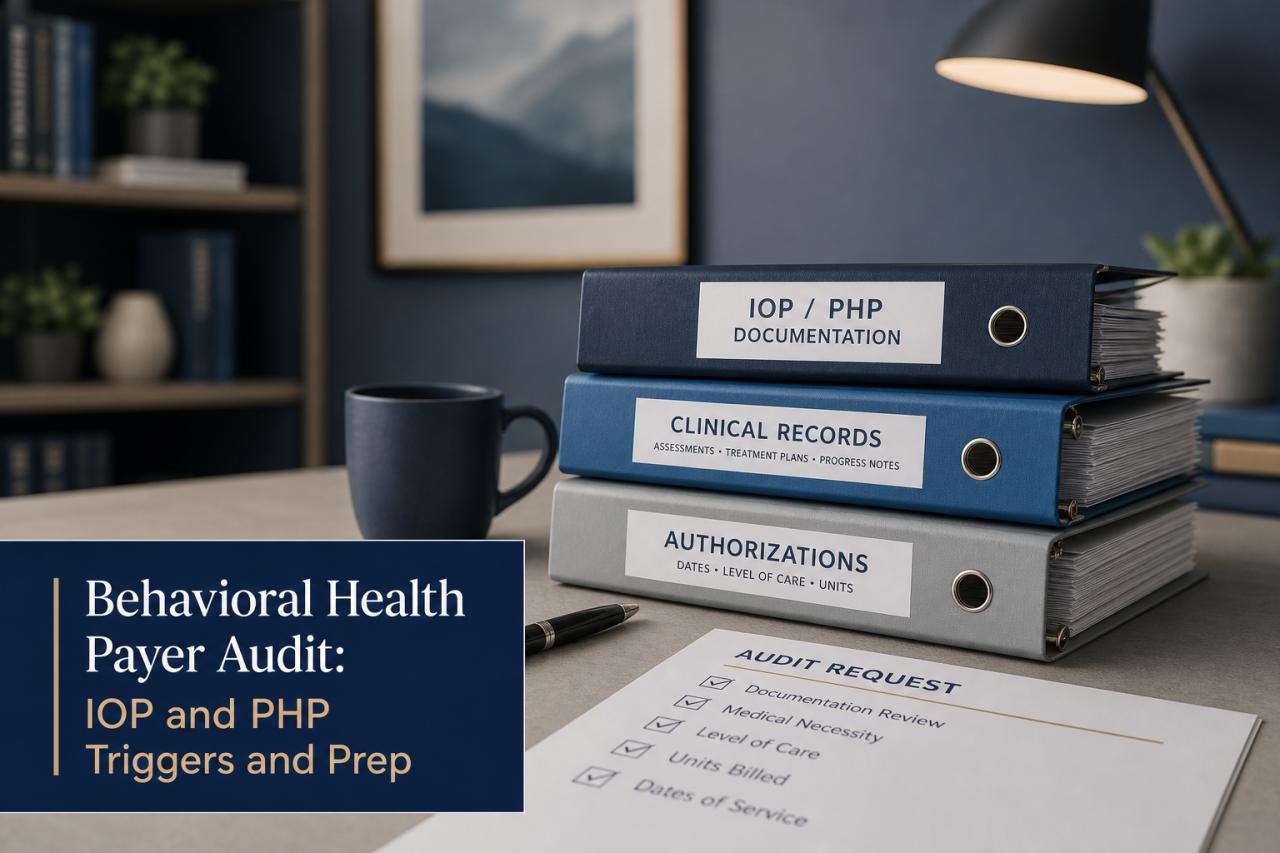
Learn which billing patterns draw payer scrutiny in IOP and PHP programs, which audit type a request letter points to, and which EHR records to pull first.
A behavioral health payer audit usually starts when your IOP or PHP billing looks different from similar programs, whether that's more units per day, a sudden jump in volume, or the same services billed for every patient. Payers compare your claims against peers and against your own history, then request records to see whether the documentation supports what you billed. You can prepare well before the letter arrives.
Payers don't pick programs at random. Their systems flag claims that fall outside the range of comparable IOP and PHP programs in the same market, and a flagged pattern often matters more than any single claim.
Units or hours per day are the most common flag. If your programs consistently bill at the top of what the payer sees from peers, a reviewer will want proof in the chart that each person actually received that much treatment. Group programming shows this fastest, because a long day of groups has to be backed by sign-in sheets and notes with start and stop times that add up.
Volume changes draw attention for a similar reason. A new site, a new payer contract, or a census jump can all be legitimate, but from the payer's side the claim line simply rises without explanation. Admissions growth that isn't matched by steady documentation practices is where reviewers tend to look next.
Uniform billing is the third flag. When every patient gets the same services, the same number of days, and the same level of care regardless of diagnosis or progress, it can read as billing by template instead of by clinical need. Reviewers expect variation, such as step-downs from PHP to IOP and discharge dates that follow clinical progress.
The fourth is documentation that doesn't support billed time or level of care. A treatment plan that was never updated, an assessment that doesn't justify PHP intensity, or an authorization that doesn't cover the dates billed can turn an ordinary claim into a recoupment finding. Our guide on medical necessity and prior authorization documentation covers what those records should show.
Rules for what triggers review vary by payer, plan, and contract, so confirm the specifics in each payer's current provider manual.
Four kinds of payer review show up most often for IOP (intensive outpatient program) and PHP (partial hospitalization program) providers, and each one asks for records at a different point in the claim's life.
A pre-payment review holds your claims before the payer pays them. The payer requests charts for specific claims, and nothing is released until a reviewer accepts the documentation. Our pre-payment review page covers how that works for behavioral health claims.
A post-payment records request comes after the claim has been paid. The payer sends a list of patients and dates of service, sets a deadline for the charts, and compares what you submitted against what you billed. If the reviewer finds gaps, the payer can seek repayment of what it paid.
Medicare reviews are the third type, and they matter most for PHP, since Medicare covers partial hospitalization. CMS (the Centers for Medicare & Medicaid Services) describes Targeted Probe and Educate, where a Medicare Administrative Contractor reviews a sample of claims and then offers education on any errors. CMS also describes the Recovery Audit Program, where Recovery Audit Contractors look for improper payments in paid claims. Medicare's partial hospitalization rules differ from commercial rules, so check the current CMS manuals before you assume one set of records satisfies both.
Commercial special investigations units (SIUs) are the fourth type. Many payers run these teams to look into suspected billing irregularities, and an SIU request can read differently from a routine records request. If the letter mentions a fraud inquiry or an investigation, bring in healthcare counsel before you send anything.
Which of these you face depends on the payer, plan, state, and contract, so confirm the process in the payer's current provider manual or the state Medicaid manual.
A pre-payment review stops your cash flow right away, while a post-payment audit puts money you've already received at risk. In the first, the claim sits unpaid until a reviewer accepts the chart. In the second, the claim was paid, and the payer is checking whether it should have been.
That timing changes what you do first. With a pre-payment review you're working against the A/R clock, so the priority is getting complete charts to the reviewer quickly and tracking which claims are pending, accepted, or denied. With a post-payment audit, the priority is the deadline in the request letter and the exact list of patients and dates of service. Missing that deadline can lead to a finding even when the care was well documented.
The two also differ in how you fix problems. A pre-payment denial can often go through appeal before any money has moved. A post-payment finding may mean the payer seeks repayment, and your options for disputing it are set by the payer's provider manual and your contract. Appeal windows and repayment procedures vary by payer, plan, and state, so read the dispute section of each manual before a request arrives.
One habit helps in both cases. Keep a log of every records request with the payer, the claim list, the deadline, who pulled the charts, and the date you sent them. If you want a second set of eyes on how your documentation would read to a reviewer, our IOP billing services and PHP billing services pages describe how we work inside your existing EHR.
Start with the request letter itself, because it names the patients, dates of service, and deadline that decide which charts you pull. Pull exactly what it lists, and ask the payer in writing to clarify anything ambiguous. Extra records can open new questions, so stay within the scope of the request.
For each patient and date of service on the list, the reviewer will expect a signed treatment plan with every update, showing goals that match the services billed. They'll look for the intake and ongoing level-of-care assessments that justify PHP or IOP intensity, including any step-down decisions. The authorization comes next, with its reference number, covered dates, and units matched against the dates you billed.
Progress notes need start and stop times, the clinician's signature and credentials, and content that reflects what happened in that session. For every group you billed, pull the sign-in sheet, with times that agree with the notes.
Before you send anything, compare the pieces against each other. A note that says a group ran 90 minutes while the sign-in sheet shows 60 is the kind of mismatch that produces a finding, and it's far better for you to catch it first. Also confirm that every claim line, from the units billed to the level of care, traces back to a specific note and an active authorization.
If a record is missing, don't recreate it or backfill signatures after the request arrives. Note the gap in your request log and ask healthcare counsel or your compliance lead how to handle it. Required documentation varies by payer, plan, and contract, so check the payer's current provider manual for its list.
Read the request letter the day it arrives and put the response deadline on a shared calendar, because the clock usually starts on the date of the letter, not the date someone opens it. Payers set their own windows, so confirm the exact timeline in the letter and in the payer's current provider manual.
Assign one person to own the response, usually your compliance lead or billing manager, and give them a single point of contact at the payer. When several staff members answer separately, records get duplicated and answers conflict. If you've kept the request log, this is where it pays off, since the owner can see which charts are pulled, reviewed, and sent.
Send the records through the channel the payer specifies, whether that's a secure portal, encrypted email, or tracked mail. Keep proof of delivery and a copy of exactly what you sent, in the same order you sent it. A cover letter listing each patient, date of service, and document included makes it easy for the reviewer to confirm nothing is missing.
If you can't meet the deadline, ask for an extension in writing before it passes, and keep the payer's reply.
When reviewers send follow-up questions, answer only what they ask, in writing, and attach the chart pages that support the answer. Any letter that mentions a fraud inquiry or investigation belongs in front of healthcare counsel before you reply.
Facilities that work with us bring us into this process because our onboarding begins with an audit of your documentation, and we work inside your existing EHR, so your clinical staff don't have to learn new software to support a response.
The findings letter usually arrives as a written determination that accepts your claims, denies some or all of them, or asks for repayment of amounts already paid. Read it for three things: which claims and dates of service are affected, the reason the reviewer gave for each, and the date by which you must dispute it.
Reasons tend to fall into a few groups. Time billed that didn't match the notes, an authorization that didn't cover the dates, and a level-of-care assessment that didn't support PHP intensity each call for a different response. Sorting findings by reason shows you which are documentation gaps you can answer with existing records and which point to a pattern you need to correct going forward.
Check the dispute section of the payer's current provider manual and your contract before you respond. Appeal levels, filing windows, and repayment procedures vary by payer, plan, and state, and a missed window can close options that were open the week before. Put the appeal deadline on the same shared calendar you used for the records request.
If you appeal, answer each finding separately and attach the specific chart pages that support it. For medical necessity findings, a letter that ties the assessment, the treatment plan, and the authorization together is stronger than a general statement that care was necessary. Our denial management and appeals work follows the same pattern, with root-cause analysis on every denial.
Once the matter closes, trace each finding back to its source. Update the documentation habits, templates, or authorization checks that produced it, since payers often compare your next set of claims against this one.
If you'd like help reading a findings letter or want your documentation reviewed before the next request, ask for a free facility billing audit at /contact-us or call us at 949-676-2252.
This post is educational and not legal or coding advice.
About the Author
Behavioral Health Billing Team
In This Article
Topics


Cipher Billing specializes in behavioral health revenue cycle management. Reach out for a free consultation and see how we can maximize your reimbursements.