


Billing & Coding
H0047 CPT Code: When to Bill the Not-Otherwise-Specified SUD Code
9 min read
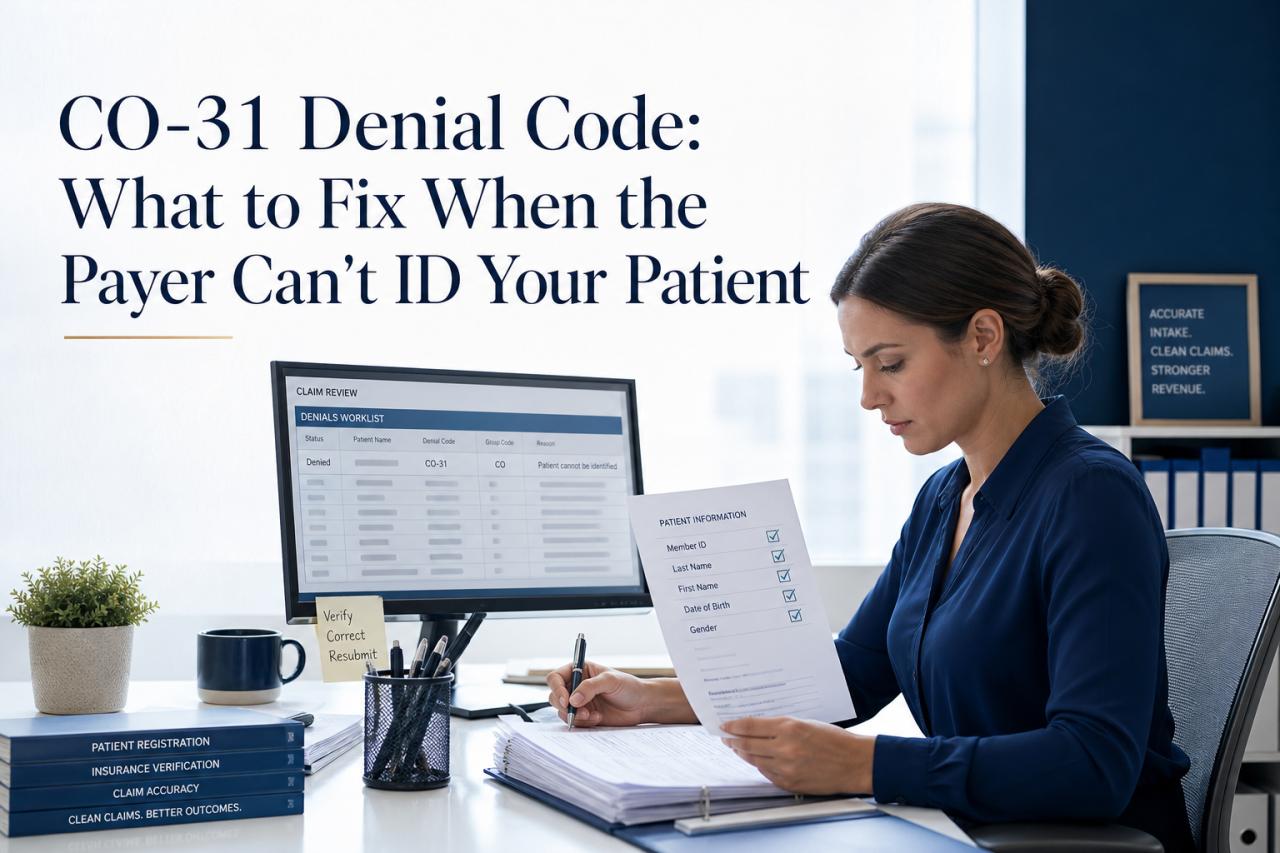
A CO-31 is usually a registration mismatch you can fix with a corrected claim. Here are the five fields to check first and where at intake the error tends to start.
Cipher Billing
Behavioral Health Billing Team
A CO-31 is usually a registration mismatch you can fix with a corrected claim. Here are the five fields to check first and where at intake the error tends to start.
A co31 denial code means the payer couldn't match your claim to anyone in its system, so the claim stopped before benefits were ever checked. Group code CO puts the adjustment on your facility, not the patient, until the claim is corrected. Most of the time the cause is a typo or mismatch that started at intake, and a corrected claim fixes it faster than an appeal.
On the remittance advice, CARC 31 reads "patient cannot be identified as our insured." CARC stands for claim adjustment reason code, and you can confirm the exact wording on the X12 claim adjustment reason code list. The payer isn't saying the person lacks coverage. It's saying the identifiers on your claim didn't land on any member record.
The "CO" in front of the number is the group code for contractual obligation, which means the provider carries the adjustment. You can't bill the patient for the balance while the denial stands, because the mismatch came from information the facility submitted.
You'll usually see the denial on the 835 electronic remittance, paired with a remark code that hints at which field failed. Read that remark code before you touch anything else, since it often points to the member ID, the name, or the date of birth.
Payer systems differ in how strictly they match. Some reject on a single transposed digit, while others tolerate a nickname or a missing suffix, so check the payer's current provider manual before assuming a pattern from another carrier.
Because the payer never reached benefits or medical necessity review, the clinical record isn't the problem and an appeal letter has nothing to argue. The problem sits in the registration data, so the intake record and the insurance card are your starting documents.
Most CO-31 denials trace back to a few moments at the front desk or on the admission call, when someone keys in what a patient says or what a card shows. Phone admissions are the most exposed, because the coordinator is typing from a spoken ID and a spoken spelling while a person in crisis or early withdrawal is trying to answer questions.
The member ID is the usual culprit. Cards often carry a three-letter prefix before the numbers, and that prefix tells the payer which plan or network the member belongs to. If the prefix gets dropped, or a zero and the letter O get swapped, the ID points to no one. Photographing both sides of the card at admission removes most of the guesswork, since the back sometimes shows a different payer ID or claims address than the front.
Name and date of birth errors come next. Patients give nicknames, shortened first names, or a married name that doesn't match the policy, and hyphenated surnames and suffixes like Jr. get split or dropped in the registration system. A birth date entered day-first instead of month-first can pass every internal check and still fail at the payer.
The subscriber and dependent mix-up surprises people. When a young adult is covered under a parent's plan, the claim has to carry the subscriber's information in the subscriber fields and the patient's own details in the patient fields. Entering the patient as the subscriber is common, and the payer then searches for a member who doesn't exist under that ID.
Stale coverage produces this denial too. A patient who changed jobs or plans may hand you last year's card, and the claim goes out against a policy that's no longer active.
Pull three documents side by side before you change anything: the denied claim, the photo of the card (front and back), and the eligibility response from the date of admission. The eligibility response is the payer's own record of the member, so when the card and the response disagree, the response is the version your claim has to match. Our verification of benefits process is built around capturing that response at admission, and your intake team can use the same habit. The insurance verification template for behavioral health intake shows the fields worth recording.
Then check the claim one field at a time.
Mark the first field that doesn't match and fix only that one. If every field matches and the denial still stands, call the payer's provider line and ask which identifier failed on their side. The eligibility versus benefits guide for intake teams explains why the eligibility response and the benefits detail are two separate checks.
Correct and resubmit. An appeal asks the payer to review a decision it made on the merits, and with CO-31 the payer made no decision about your patient's care or coverage. It never found the member, so there's nothing for an appeal letter to overturn.
The sequence that works for most payers has three steps.
Check timely filing before anything else. Filing limits still apply to a corrected claim, and each payer sets its own window and its own starting date, so read that limit in the provider manual or your contract before the account sits another week. If a claim has aged out, your contract language and the payer's reconsideration process decide what options remain.
An appeal only makes sense in one case. If the payer still says it can't identify the patient after every field matches its own eligibility response, ask for a claim review through the provider line and document the call. That's a payer-side matching problem, and it's the exception.
Our denial management and code library groups these denials by cause, which helps A/R teams separate registration fixes from true appeals.
Three denials can look alike in a work queue, but each one sends you somewhere different. CO-31 means the payer couldn't find the patient. CO-22 means the payer found coverage but believes another plan should pay first, so the fix is coordination of benefits. CO-16 means the claim is missing information or has an error, so the fix is whatever the remark code names as absent or invalid.
The practical test is the remark code plus the eligibility response. If the response comes back empty or shows a different person, you're looking at CO-31 and the match check above applies. If it shows active coverage for the right member but lists another carrier as primary, that's CO-22, so ask the patient or subscriber about other coverage, update the record, and bill the primary payer first.
CO-16 is the one most often confused with CO-31, because a mistyped identifier can produce either code depending on the payer. Some payers return CO-16 with a remark code for an invalid member ID, while others return CO-31 for the same mistake. Read the remark code on the 835 before you decide which denial you have, and don't rely on the CARC number alone.
All three are usually worked as corrections rather than appeals, since the payer hasn't ruled on medical necessity.
Run eligibility on the same day you take the admission call, and key the member ID, name, and birth date straight from the card photo and the payer's response rather than from what the patient says aloud. That one habit removes most of the typing and hearing errors described above. Admissions staff are often working with someone in distress, so a second person comparing the registration screen to the card image before the account is released to billing catches what the first person can't see.
Build the check into the admission workflow itself. The coordinator confirms the five fields from the match check, notes which document each one came from, and flags any mismatch before the claim exists. Coverage that changes mid-stay, such as a plan switch or a new employer, calls for a fresh eligibility run instead of reusing the admission-day response.
When a CO-31 does come back, send it to the intake team as well as the billing team. Billers fix the claim, but intake needs to see which field failed so the same error doesn't repeat on the next admission. Sorting denials by the failed field, not just by code, shows you whether the problem is phone transcription, dependent entry, or stale cards.
Our onboarding starts with an audit of your documentation before any claims go out, so registration gaps like these surface early. We work inside your existing EHR, whether that's Kipu, Sunwave, or ZenCharts, so your intake staff don't have to learn new software, and your facility gets a dedicated U.S.-based Partner Experience Executive. You can request a free facility billing audit at our contact page, and we'll review your intake-to-claim workflow for the mismatches that produce CO-31 denials.
This post is educational and isn't legal or coding advice. Payer rules vary by plan, state, and contract, so confirm details in each payer's current provider manual.
About the Author
Behavioral Health Billing Team
In This Article
Topics


Cipher Billing specializes in behavioral health revenue cycle management. Reach out for a free consultation and see how we can maximize your reimbursements.